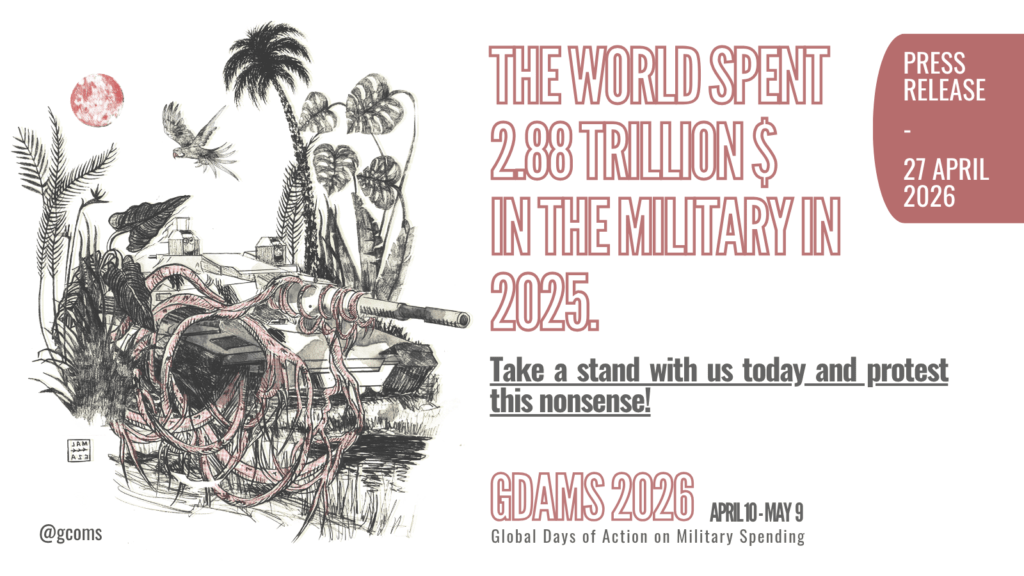
SIPRI / STOCKHOLM INTERNATIONAL PEACE RESEARCH INSTITUTE has just published new data on military spending for the year 2025, and the figures show a new growth in military spending, reaching $2.88 trillion, an increase of 2.9% compared to last year, marking he 11th consecutive year of growth and the highest spending level ever recorded by SIPRI. Global military expenditure rose in 2025 despite a drop in spending by the United States, the world’s biggest spender. A sharp increase in European spending and continued growth in Asia and Oceania were more than enough to offset the decrease in US spending during the year. World military expenditure excluding the USA grew by 9.2 per cent in 2025. The five biggest spenders in 2025 were the United States, China, Russia, Germany and India, which together accounted for 58% of world military spending. The USA’s military spending fell by 7.5 per cent to $954 billion in 2025, while China’s spending rose by 7.4 per cent to an estimated $336 billion.
In 2025, the total spending by all 32 NATO members exceeded $1.58 trillion $USD and accounted for 55% of the world’s total. USA spending accounts for 60% of NATO’s total.
You can find the SIPRI publication Trends in World Military Expenditure, 2025 | SIPRI
info: https://ipb.org/:
Military spending and arms production require unsustainable levels of resources, both financially and natural resources (i.e. oil, rare earth minerals, production capacities). As a result, these resources are not available for other areas of society, including public services like education, healthcare, and a green transition. At the same time, both the production of arms and their use have lasting impacts on the environment that last longer than the arms themselves. Sustainable development refers to “a holistic approach aimed at balancing economic growth, social inclusion, and environmental protection to meet current needs without compromising future generations” (UN website). Disarmament efforts, and the freeing up of resources, should contribute to investment in development for all, including future generations. |
Global military spending reached $2.9 trillion in 2024, marking ten consecutive years of growth, with over 100 countries increasing their military budgets and the top ten spenders accounting for 73% of global expenditure. Yet this unprecedented militarization has not produced a more peaceful world. Armed conflicts, geopolitical tensions, and humanitarian crises remain widespread. If increasing military budgets were the key to security, we would expect the most militarized era in history to also be the safest. Instead, insecurity persists. In fact, the increase in military spending has led to a new arms race which increases perceived threats and insecurity of all while producing more deadly military weaponry for use in war. |
The opportunity cost of militarization is enormous. For example:10% of global military spending ($230–280 billion) could eliminate the global extreme poverty gap.
|
Weapons have all kinds of negative effects, but they are especially devastating in developing societies and poor communities generally. Examples include landmines and cluster bombs (land rendered unusable, farmers mutilated); small arms (increasing crime levels, high medical care costs); depleted uranium (radioactive contamination of areas affected by military activity); conventional weapons (destruction of people, housing, crops, land, infrastructure…). Sustainable disarmament programmes promote sustainable development through removing a whole series of dangers for local communities, and by empowering them to respond collectively to these challenges. The world has the resources to address these challenges. The real question is how we choose to allocate them. |
If current trends continue, global military spending could reach:
That would be five times higher than global military spending at the end of the Cold War. The question facing humanity is not simply how much we spend on defense — but whether endless militarization can ever deliver the security people actually need. 📅 Take action. Join #GDAMS from 9 April to 10 May 2026.
|
🌐 More info: https://ipb.org/