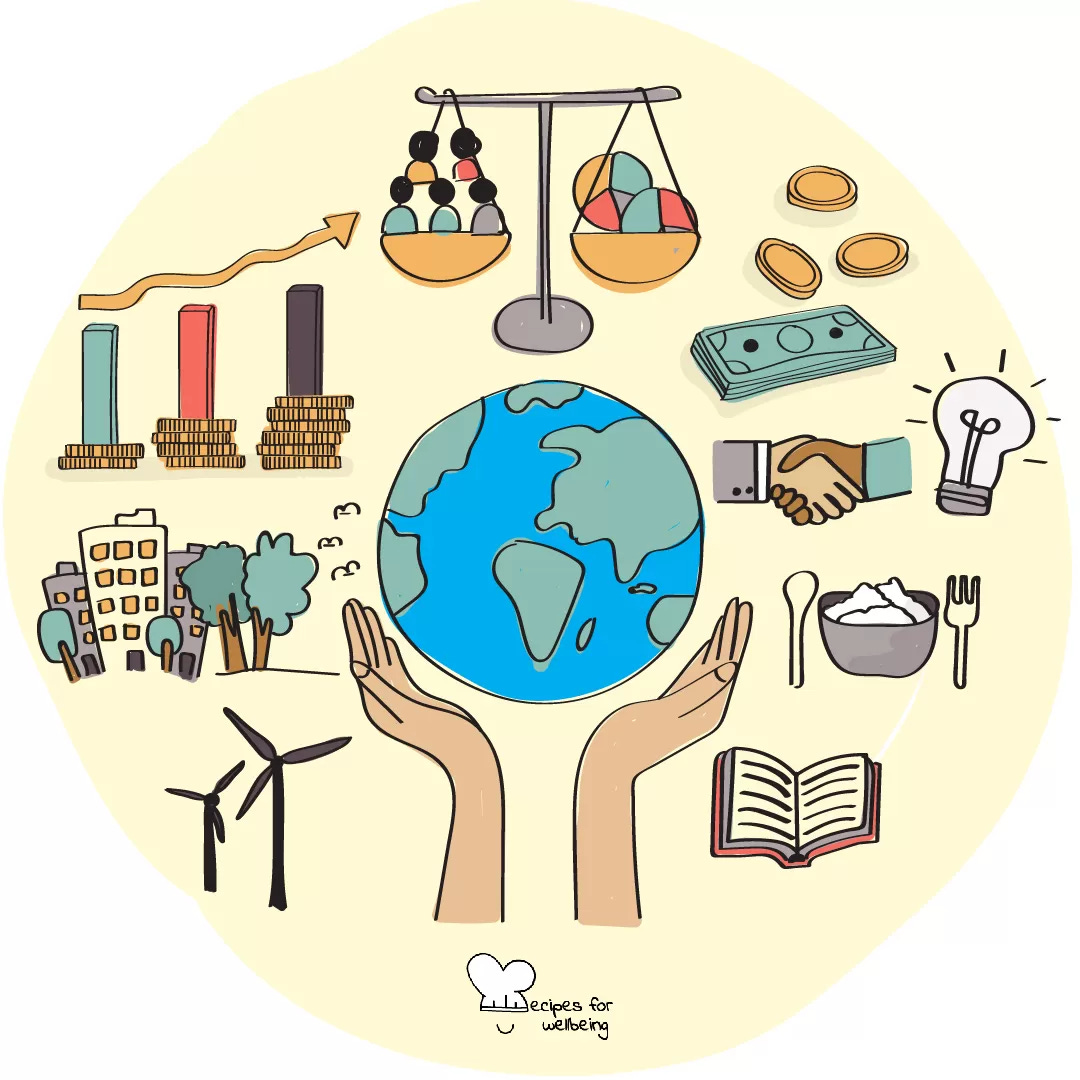
What do we mean when we speak about the commons?
When discussing the commons, it is methodologically important to clarify what exactly we are referring to. This is necessary because there is often a tendency to attribute to the commons anything considered positive or well-intentioned. However, such conceptual vagueness does not benefit the commons, especially when moving into the field of applied public policy.
A common good does not exist as such in and of itself. It presupposes recognition and management as a common resource by a community that expresses the will to govern it collectively, together with the relationships and formal or informal rules developed among its members.
The commons as a political project are still at an early stage, lacking a unified programme of applied policies and clear alliances. Yet, although they have not been promoted by elites or political parties, commons-based practices are increasingly emerging simultaneously in different parts of the world.
Any discussion about productive reconstruction from the perspective of social justice and environmental sustainability can no longer ignore the commons as part of our shared heritage.
The commons constitute a social form that has accompanied humanity throughout its evolutionary course. They survived in the shadows of market culture and, in recent years, have re-emerged as a potential alternative to the pressing crises we face today. Water, land, DNA, the seabed and many other resources now require protection under almost existential conditions.
Most interestingly, however, the commons and peer production are now returning with emphasis on their developmental potential. Digital transformation intensifies this tendency, which now requires institutional support through properly designed public policies.
Their additional characteristic — strengthening democracy through participation in decision-making, empowering communities and applying the principle of subsidiarity — makes the commons part of the answer to multiple contemporary challenges.
The new conceptual framework of the commons, despite its long historical background, has begun to unify different struggles around the world. Over the last two decades, communities of commoners have increasingly recognized each other, since this practice applies to a wide range of heterogeneous resources and sectors of social life.
New governance functions based on commons principles, emphasizing self-organization and participation, are being applied to manage a broad spectrum of resources: both traditional ones (rivers, forests, indigenous cultures) and emerging ones (solar energy, technological innovation, the internet). They seek new definitions of value, both economically and philosophically, challenging the established assumptions of the neoliberal economic and political order.
The discussion is vast and cannot be exhausted within this framework. The following focuses on the case of Public-Commons Partnerships as one of the critical tools for strengthening the commons within applied public policy.
The Italian Case
The legal foundation of the Bologna Regulation lies in the principle of horizontal subsidiarity, established in Article 118 of the Italian Constitution, which encourages local authorities to involve citizens in the management of public goods.
At the heart of the regulation is Article 5, defining the “collaboration pact.” This is a contractual agreement similar to private-law contracts and is signed jointly by the city administration and citizens.
The collaboration pact enables municipalities to cooperate with residents and other actors — such as NGOs, local entrepreneurs, civil society organizations, research institutes and cultural bodies — for the “care and sustainability” of urban commons. In practice, it provides institutional support for Public-Commons Partnerships, unlocking significant potential.
These possibilities were rapidly utilized, leading to the creation of a broad municipal network throughout Italy. Hundreds of such agreements have already been signed and continue to increase. Indicatively, in Bologna alone, 280 Public-Commons Partnerships were signed between 2014 and 2016.
The Bologna example inspired many other Italian cities to adopt similar frameworks, resulting in corresponding partnerships in more than 250 cities across the country, including Turin, Milan, Rome, Naples and Florence.
A coherent strategy has been implemented for the use of abandoned or unused public assets and their transformation into collaborative spaces. In addition, many Public-Commons Partnership programmes specifically target the support of poorer social groups.
Most importantly, the Bologna institutional model is constitutionally grounded, securing its operation and ensuring independence from the central state and elected local representatives. As a legal model, it is more resilient to political changes, while formal legal recognition provides security and incentives for citizens to engage in urban commons production.
Moreover, the Bologna methodology has proven capable of convincing local authorities, diverse stakeholder groups, businesses and ordinary middle-class citizens who are often reluctant to engage in party politics.
Public-Commons Partnerships Worldwide
Public-Commons Partnerships take different institutional forms and cover a wide range of resources and services. They are implemented globally — from the United States to Brazil, from the United Kingdom to India — addressing real and urgent community needs.
In 2021, the Transnational Institute (TNI) studied and documented 80 Public-Commons Partnership cases worldwide, using methodological criteria related to ownership structures, governance and financing.
Cities and citizens have developed innovative institutional interventions involving:
- just energy transition,
- empowerment of citizens and care workers,
- cooperative food production networks,
- non-profit urban development cooperatives,
- and many other shared resources.
Public ownership plays a crucial role in climate protection and social inclusion, while Public-Commons Partnerships are vital tools for ensuring democratic management of public resources.
It is clear that Public-Commons Partnerships are not intended to replace the responsibilities of the public sector, but rather to create additional social and democratic value. Strong and adequately funded public institutions remain the necessary starting point.
Within these efforts, policies such as public and collective ownership, co-governance and innovative financing mechanisms are utilized to strengthen such initiatives further.
Essentially, this concerns not simply a policy instrument, but the search for new forms of ownership — a development with profound political implications.
Common to all cases is the political decision by local authorities and communities to develop participatory mechanisms for democratic management of public services, emphasizing procurement policies and socially-oriented criteria.
New institutions are emerging to support these partnerships, oversee policy implementation, provide knowledge and training, and expand opportunities.
Main Strategies Used in Public-Commons Partnerships
Public and collective ownership
- Acquisition and decommodification of land and properties
- Co-ownership of local infrastructure
- Co-ownership of public utility services
Co-governance
- Public-Commons institutions
- Committees representing commons communities within public institutions
- Permanent participatory committees integrated into existing public institutions
Innovative financing methods
- Reinvestment of profits into communities
- Creative public procurement policies
Legal forms such as Community Interest Companies may be useful under certain conditions, but may not suit every type of resource or region.
Models cannot simply be transferred mechanically. They require “translation” into different legal and social environments.
Global Trends in Public-Commons Partnerships
Energy sector
There is great diversity in the energy field. In almost all cases, energy poverty is treated as a central challenge within energy transition strategies.
Partnerships are based on public-community co-ownership of local infrastructure and energy services (e.g. Wolfhagen in Germany, Cádiz in Spain, Plymouth in the UK).
Agriculture and public utilities
Public ownership of agricultural land and utilities — especially water — plays a major role.
Municipalities promote sustainable agriculture by cooperating with farmers and using public procurement to purchase local goods and services. This creates:
- healthier environments,
- better nutrition,
- sustainable farming,
- local jobs,
- and local economic development (e.g. Rennes, France).
Housing and anti-speculation policies
In many cities, struggles against excessive rent increases and over-tourism are intensifying.
The consequences of mass privatization of municipal housing led to the creation of Public-Commons Partnerships for co-management of housing assets with communities (e.g. Haringey, London).
Self-financing potential
Public-Commons Partnerships do not necessarily impose additional economic burdens on local communities and can become self-financing.
Local authorities can use their financial capacities to develop locally owned infrastructure generating profits that are reinvested into community-benefit programmes (e.g. Lazio, Haringey, Plymouth, Burlington, Vermont).
Labour rights and decent work
Through Public-Commons Partnerships, local authorities can create decent jobs and strengthen labour rights.
This often begins by ending contracts with multinational corporations in welfare and cleaning services, followed by support for worker cooperatives through public procurement mechanisms (e.g. Recoleta, Chile).
The Preston Model
Special mention should be made of the Preston Model in the United Kingdom, where many of the above principles have been applied successfully for more than a decade.
Following the 2008 financial crash, Preston faced severe economic and social challenges. The University of Central Lancashire and Preston City Council explored how cooperatives could help increase local investment, inspired partly by the Mondragón model in Spain.
The adopted solutions transformed the local economy and became internationally known as the Preston Model — now considered a global reference point for community wealth building.
Initially, they increased local investment by changing public spending and procurement priorities. Without abandoning quality and cost-efficiency, they introduced an additional criterion: buying from local suppliers.
This generated multiple benefits. They also promoted:
- quality employment,
- cooperative enterprises,
- democratic management structures,
- stronger citizenship and democratic participation.
Local procurement increased from 39% in 2012/13 to 80% in 2016/17 — an increase of approximately £200 million.
They also:
- expanded the real living wage,
- established community banks,
- created public pension investments,
- secured worker ownership,
- connected municipal enterprises to local procurement strategies.
Residents and businesses actively participated in designing these policies.
This approach fundamentally challenges the dominant model of municipal economic policy based on attracting large corporations, outsourcing procurement, speculative real-estate projects and expensive prestige events.
Instead, it emphasizes:
- expansion of the public and social economy,
- fairer wages,
- greater worker control,
- stronger environmental and social responsibility.
Its goal is to generate wealth within the community through the actual functioning of the economy, rather than through uncertain redistribution mechanisms afterward.
Conclusion
The commons movement, situated at the margins of dominant political economy, is shaping a new paradigm addressing the dysfunctions produced by the exclusive dominance of states and markets in organizing collective life.
Strengthening this trend requires:
- innovative legal frameworks,
- supportive public policies,
- interventions at all levels of governance,
- formal legal recognition of the commons.
It also requires pioneering governance institutions that encourage people to develop qualitatively different relationships with nature and with one another, assuming responsibility for social life and everyday collective management through participation in the governance of common resources.
The connection between all the above and the quality of democracy is evident.