
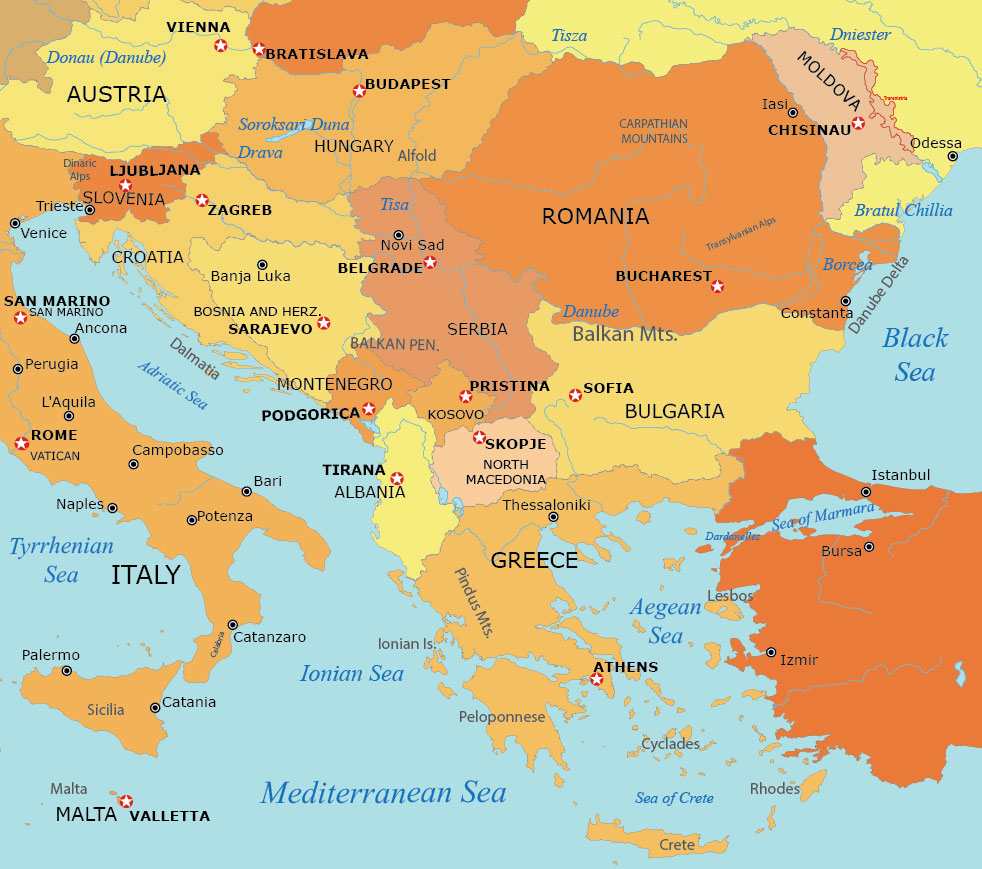
Demographic balance is a fundamental pillar of sustainable development, particularly for the countries of South-East Europe (SEE), where population ageing, shrinking labour forces, and persistent migration flows shape economic prospects, social cohesion and long-term resilience. A stable or at least manageable demographic structure supports productive economies, viable welfare systems, balanced territorial development and the capacity of states to plan for future needs in education, healthcare, infrastructure and climate adaptation. In SEE—where demographic pressures are often more intense than in the EU-27 average—the challenge is twofold: addressing rapid ageing and depopulation in many regions, while ensuring that migration, urbanisation and workforce dynamics support inclusive, sustainable growth rather than deepen existing inequalities.
Demographic Overview – Key Indicators per Country
The EU-27 is entering a phase of slow or near-zero population growth. Natural population change is negative, driven by a long-term decline in births combined with increasing life expectancy. The fertility rate is now well below the replacement level, while the share of the population aged 65+ continues to rise. Net migration is the primary factor supporting population stability. This demographic context forms the backdrop against which SEE countries must be assessed.
South-East Europe displays a wide demographic spectrum, from the heavily aged and shrinking populations of Italy, Greece, Bulgaria and Romania to the younger but rapidly transforming demographic landscape of Türkiye and the migrant-driven growth of Malta and Cyprus. The Western Balkans, though still slightly younger, face severe depopulation risks due to persistent emigration and low fertility. Achieving sustainable development in this context requires targeted policies to strengthen human capital, address regional imbalances, manage migration strategically and support families in ways that stabilise demographic structures. The future prosperity and institutional resilience of SEE countries depend on how effectively they can navigate these demographic transitions and align them with broader economic and social development goals.
| Country | Median Age (approx.) / Age profile | Total Fertility Rate (TFR) | Recent Population Trend / Remarks |
| EU-27 (average / benchmark) | Median age ~ 44.7 years (2024) | 1.38 births/woman (2023) | Natural decrease (more deaths than births), net migration positive — slight net growth. |
| Greece | High — reported median age ~ 44.2 years; share 65+ about 25.4% (2023) | ~ 1.4 births/woman | Population shrinking modestly; rapid ageing; youth out-migration. |
| Italy | Highest in EU: median age 48.4 years (2023) | Very low TFR (well below replacement) — among lowest in Europe. | Persistent population ageing; many regions experiencing decline, especially rural / southern areas. |
| Bulgaria | Among the oldest in EU: median age ~ 46.8 years (2023) | 1.81 births/woman (2023) – highest in EU in that year. | Long-term population decline due to past low fertility and emigration; ageing population. |
| Romania | Median age increasing significantly (rise of ~8.3 years from 2003 to 2023) | Below replacement; fertility among lowest but slightly above some southern countries. | Population decline, strong emigration, rural depopulation, ageing demographics. |
| Croatia | Similar ageing and low fertility trends; significant demographic decline — many regions shrinking (not in same Eurostat summary but matches regional SEE pattern) | Low fertility (below replacement) — comparable to other Southern/Eastern European states | Steady population decline; internal migration to coast/urban areas; rural depopulation. |
| Slovenia | Moderate — though ageing, equipped with better balance than Balkan peers; more stable age structure among SEE countries | TFR below replacement, but inflows help stabilize population | Population relatively more stable due to net immigration, though long-term ageing persists. |
| Malta | Youngest among many EU countries — median age lower than core EU average (≥ 40.1 years in 2023) | Very low TFR (~ 1.06 births/woman in 2023 — lowest in EU) | Population growing thanks to immigration despite natural decrease. |
| Cyprus | Younger than many Southern EU countries — median age among the lowest in EU (~ 38.4 years in 2023) | Low to modest fertility (below replacement) — similar to other small European states | Population growing (or stable) due to immigration, not natural increase. |
| Western Balkans (Serbia, Montenegro, Albania, N. Macedonia, Bosnia-Herzegovina, Kossovo) | Still somewhat younger overall than core EU, but ageing rapidly; median age and dependency ratios rising (data vary per country) | TFR below or around replacement in most cases (e.g. Albania ~ 1.21) | Population stagnant or declining due to low fertility + high emigration; risk of workforce shrinkage and regional depopulation. |
| Türkiye | Younger population compared to EU; higher share of working-age people; median age lower than European averages; demographic “younger base” for now (global UN projections) | Fertility declining (but higher than many European countries), gradually approaching European norms | Population still growing, but growth slowing; demographic transition toward ageing underway. |
Key References
Balkan Barometer / Regional Cooperation Council (RCC)
Provides regional demographic perceptions, migration intentions and social indicators complementing official statistics.
https://www.rcc.int
Eurostat – Demography and Population Statistics
Core source for EU-27 and Member State data: fertility, ageing, migration, population projections.
https://ec.europa.eu/eurostat
United Nations – World Population Prospects (UN DESA)
Global standard for demographic indicators (population size, median age, fertility, mortality) including Türkiye and Western Balkans.
https://population.un.org/wpp
World Bank – World Development Indicators (WDI)
Data for all SEE countries: population trends, age dependency ratios, migration patterns.
https://data.worldbank.org
OECD – Demographic and Social Indicators
Especially useful for EU countries and Türkiye: ageing, labour force trends, family and social policy indicators.
https://www.oecd.org/statistics
UNDP – Human Development Report & Statistical Annex
Includes HDI, life expectancy, education metrics, and demographic components of human development.
https://hdr.undp.org
Eurostat – Regions and Cities / Demography Yearbook
Provides territorial demographic patterns (urban–rural, regional ageing, migration flows).
https://ec.europa.eu/eurostat/web/regions-and-cities
European Commission – Ageing Report (DG ECFIN)
Analytical reference for long-term demographic projections and their economic impact.
https://economy-finance.ec.europa.eu
UNICEF & UNFPA – Reports on Demographic Change in the Western Balkans
Covers youth, ageing, fertility trends and migration for non-EU SEE countries.
https://www.unfpa.org / https://www.unicef.org
European Training Foundation (ETF) – Labour Migration & Skills in the Western Balkans
Analysis focused on emigration, labour shortages and demographic transitions.
https://www.etf.europa.eu