When Christopher Columbus sailed from Andalusia to the Americas in 1492, and Vasco da Gama sailed from Lisbon in 1497 and, after rounding Africa, reached India, the two of them laid the foundations for Europe’s expansion toward America, Africa and Asia, creating the first global trading system.
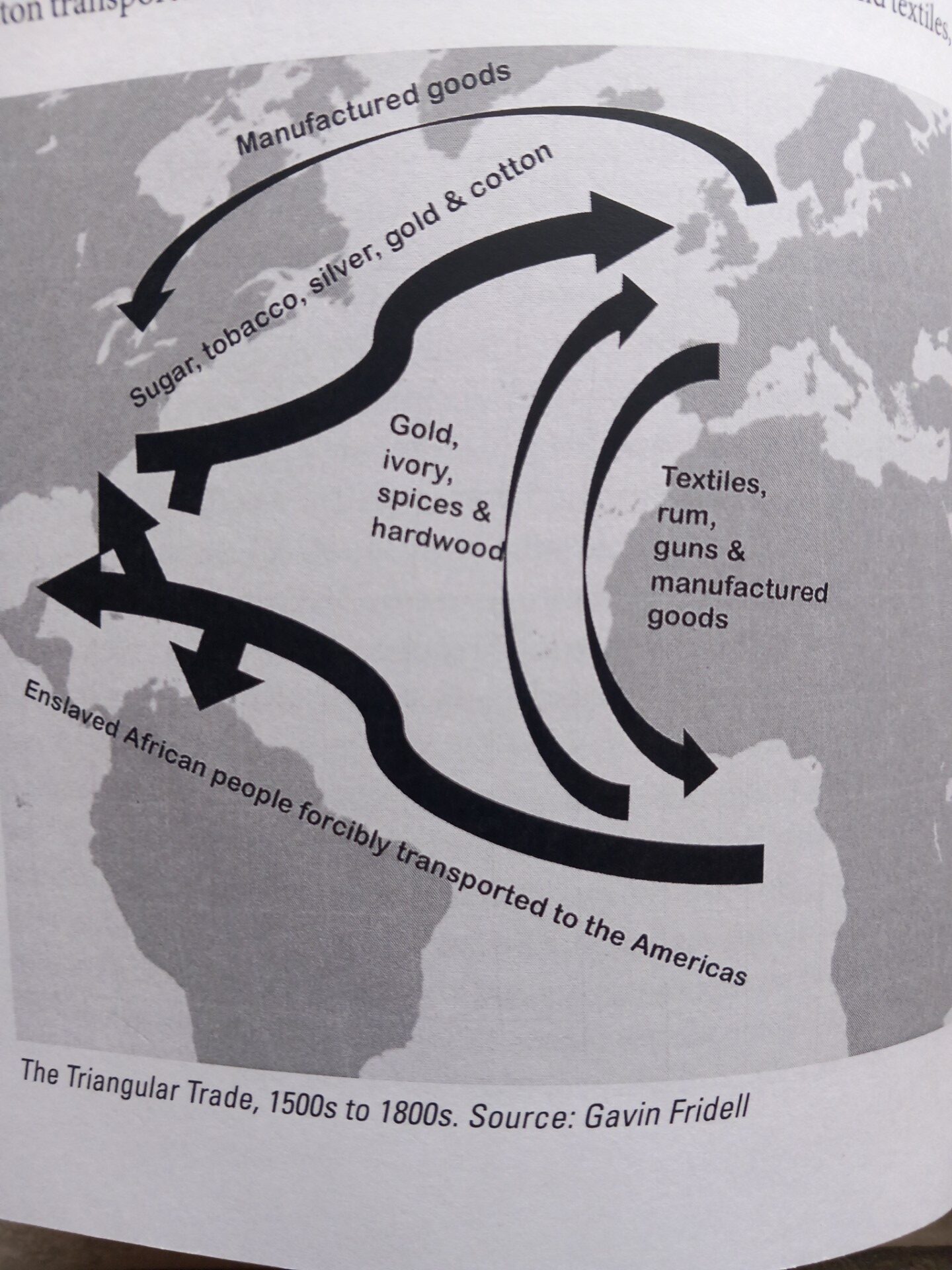
In the four centuries of European colonialism that followed, dozens of trading companies established their own private armies at the hubs of maritime trade routes, with the support of their states. The Dutch East India Company and later the English East India Company, with hundreds of merchant ships and tens of thousands of soldiers, controlled over 50% of international trade in cotton, silk, salt, tea, spices and opium. Under the “triangular trade” and through the use of violence, they transported 15 million enslaved people from West Africa to work on the plantations of their colonies in the Americas. They then transported the production of sugar, tobacco, gold and cotton from the Americas to England, and spices, ivory and timber from Africa to Europe. There they produced textiles, rum, weapons and other industrial goods, which they transported for consumption and use in West Africa and the Americas. Profits for the trading companies of the European states were enormous and contributed to the success of the technological and industrial revolutions of the 18th and 19th centuries in England, France and Germany, according to Piketty (2020), Capital and Ideology.
International trade was organised on the basis of a centre (European metropolises) and a periphery (raw-material colonies), establishing an unequal exchange: industrial products in return for agricultural and mineral raw materials. With the First Industrial Revolution (1760–1840), this model was strengthened. Europe’s industrial economies sought raw materials and markets, often imposing trade agreements by force and destroying local productive structures.
By the end of the 19th century, the world entered a first, intense phase of globalisation. Railways, steamships and the telegraph connected markets; international trade surged; and capital moved almost freely under the gold standard. This period, often idealised as the Belle Époque, produced enormous wealth—but also deep imbalances. Wealth concentrated in narrow economic elites, while large parts of society remained outside prosperity. At the same time, the great powers entered an increasingly intense commercial and geopolitical competition for markets, raw materials and spheres of influence.
From the late 19th century, anti-colonial national liberation movements emerged, intra-imperialist trade rivalries intensified, and social contestation grew. World War I was an expression of these rivalries, while the founding of the League of Nations in 1919 attempted to institutionalise a new framework of international cooperation—without the participation of the United States—yet without overcoming colonial hierarchies.
The financial collapse of 1929 revealed all these structural weaknesses. The crisis, which began as a stock market shock in the United States, turned into a global depression. Instead of a coordinated international response, states resorted to economic nationalism. The culmination was the U.S. Smoot–Hawley Act of 1930, which drastically raised tariffs on thousands of products. Trading partners retaliated, and the world entered a generalized “tariff war.” International trade collapsed, export economies suffocated, and the depression deepened.
Thus, the over-concentration of wealth produced by the first globalisation, the failure of international institutions, and the shift from economic cooperation to protectionism created an explosive mix. Economic collapse fuelled social despair and political radicalisation. The failure of the League of Nations to prevent economic nationalism and the rise of fascism led to the new global conflict of World War II. In this environment, nationalism and authoritarianism flourished, ultimately driving the world into a second, even more destructive, world war with 75 million dead and traumatised societies.
True institutional reconstruction began after World War II, with the founding of the UN in 1945, the ECSC in 1951 and the EEC in 1957, and the creation of a framework of multilateral economic cooperation (Bretton Woods, GATT). Although inequalities did not disappear, the foundations were laid for a new international order that sought—at least institutionally—to regulate markets through rules and to advance gradual decolonisation. The period 1945–1975 thus marked a transition from crude colonial imposition to a form of institutionalised international cooperation, where the equality of states was formally recognised as a principle of international law, even if economic and trade inequalities remained structural.
For more than 60 years—from 1947, and from 1995 onward as it was transformed into the World Trade Organization (WTO)—until the collapse of multilateral agreements in Doha in 2008, the GATT/WTO functioned effectively through negotiations and public dispute settlement, securing to a large extent the peaceful cooperation of its 168 WTO member states. The expansion of international trade after World War II is assessed positively: inter-state trade flows increased 300-fold since 1947 and today represent 60% of world trade, while over the same period global tariffs fell on average from 25% to 10% by 2020, before the start of modern tariff and trade rivalries initiated by the United States outside the WTO framework.
This was followed by the withdrawal of the United States and its allies in 2008 from the WTO’s multilateral negotiations and agreements, and the promotion of bilateral negotiations under the logic of the “law of the stronger” in international trade. In 2019 the United States also blocked, within the WTO, the appointment of public judges to the Appellate Body and state-to-state dispute settlement, promoting corporate private arbitration.
Perceiving the inability to push further market deregulation for the dominance and expansion of American companies within the WTO framework, the United States under the Trump presidency pursued a strategy of continuous undermining of the WTO and a “divide and rule” policy through new-type bilateral agreements of a neoliberal character, for the following reasons:
- Whereas the WTO provides for public dispute settlement between states, within bilateral agreements the U.S. promotes corporate arbitration, under which companies can sue governments before new corporate courts (ISDS).
- Whereas within the WTO intellectual property rules (corporate patents, PDO/PGI, organic products, new technologies, etc.) and sanitary and phytosanitary measures (GMO controls, industrial standards, public health issues) are agreed multilaterally among states, in bilateral trade agreements the lobbies representing multinational corporations participate through “regulatory cooperation” committees.
- Whereas in the WTO public policies (public procurement and services, public goods, environment and water, investment, education, culture, social rights, sustainable development of local societies and countries) are the competence of states, in bilateral trade agreements they are put on the negotiating table, with only a clause of potential exemption.
The rise of the far right in the United States and in Europe, along with the expansion of the spheres of influence of the authoritarian regimes of Russia and China and nationalist currents internationally, is both the result and the generating cause of a more aggressive neoliberal policy at the global level—one that deregulates markets, dismantles environmental and social product standards, and commodifies and privatises public goods in favour of corporate oligopolies. As a result, 50% of global wealth is now concentrated in 1% of the global business elite, creating surplus countries and deficit countries with high public debt through unfair competition, tax evasion and tax havens.
To date, the European Union has promoted the reform of the WTO—albeit with shortcomings, particularly regarding the inclusion of green policies, fundamental rights, and the agri-food sector of Southern Europe—and overall it moves in a generally positive direction compared to other dominant trade blocs, by:
- Promoting multilateral agreements and rules within the WTO framework
- Integrating into multilateral agreements the UN’s 17 Sustainable Development Goals and the objectives of the 2015 Paris Agreement on climate change—environmental protection, the circular economy, fundamental rights and biodiversity—as well as digital democracy through regulatory controls on artificial intelligence.
For these reasons, the EU’s international trade policy is not a technocratic exercise. It is deeply political: it determines who wins and who loses, which producers survive, which workers are protected, which regions develop, and which planetary resources are preserved. From the 1947 General Agreement on Tariffs and Trade to today’s shaken WTO system, the history of international trade reflects the history of power and the global interstate, economic and social balance of forces.
The European progressive approach holds that trade can be a vehicle for justice, environmental protection and social progress, provided it is governed by democratic and transparent multilateral rules—not by the power of the stronger. Today’s WTO crisis, the U.S. withdrawal from the WTO and most international organisations, and the turn of major economic powers from multilateral agreements to unilateral and bilateral practices, as well as tariff and trade wars, is not a “technical” problem; it is a threat to the very edifice of a multilateral, cooperative international order built over the past seven decades. It recalls the grey era of the interwar period.
In this context, the European Union stands at a critical turning point: it must defend the multilateral system on the basis of progressive, sustainable, socially fair international trade—trade that does not serve deregulation, but rather fair reform and a creative balance between market, society and the environment. At the same time, it must necessarily pursue bilateral trade agreements such as Mercosur, with India, China, etc. (which must not sacrifice environmental and social standards and the sustainability of its agri-food sector), and it must advance its foreign and defence policy to secure its strategic autonomy. For this policy to be sustainable amid an explosive environment and often contradictory goals, Europe must reconnect with the Enlightenment values that gave birth to it. It must move toward strategic autonomy from the United States and toward active diplomacy, using its globally recognised democratic regulatory capacity known as the “Brussels effect,” and it must not sacrifice cohesion policies by entering an arms race, with an expected damaging end for all peoples.
EUROPE’S SUSTAINABLE CHOICE TODAY
Multilateral trade with democratic social, environmental and public-health rules
The European Union and its Member States collectively constitute the world’s largest provider of humanitarian aid. Together they represent approximately 45% of global humanitarian aid recorded in the United Nations system, contributing billions of euros annually through organisations such as OCHA, UNHCR, WFP and UNICEF. In terms of economic weight, the EU’s and Member States’ humanitarian and overall official development assistance (ODA) corresponds to roughly 0.5% of the Union’s Gross National Income (GNI), making it not only the largest donor in absolute terms but also one of the most significant relative to its economic strength. This steady financial commitment highlights the EU’s role as a global humanitarian actor rooted in multilateral cooperation, international law and solidarity. This humanitarian-aid policy must continue and be expanded within the EU’s international relations.
Noteworthy as well is Cuba’s decades-long programme of health support to more than 60 countries in the Global South, mainly in Latin America and Africa, through 28,000 highly specialised doctors and health professionals, in areas facing health crises and natural disasters—generating annual revenues from medical services via inter-state agreements of $8.6 billion for the period 2015–2020 alone. In response to Covid-19, it also sent 3,000 health professionals to 40 countries, showing an example of combining economic diplomacy and solidarity.
To strengthen this direction of humanitarian assistance and active diplomacy within an autonomous foreign and defence policy with a pro-peace orientation, the EU should move toward:
- Non-approval by the European Parliament of Mercosur and EU–US agreements, so that they can be renegotiated with the incorporation of European environmental, social and health standards.
- Energy decoupling from the United States and Russia within the EU’s new 10-year planning framework.
- EU strategic autonomy from the United States, with a common foreign and defence policy and the promotion of cooperation with BRICS and developing countries.
- Pro-peace diplomatic initiatives by the EU to end wars in Ukraine, in Palestinian Gaza and the West Bank, in Sudan, etc.
- Defence of the common trade policy and of Cohesion Policy and CAP resources and institutions in the new period 2028–2034, which are proposed to be reduced by 37% (cohesion) and 23% (CAP), with the abolition of Regional Operational Programmes and centralisation into 27 “executive” national programmes.
- Revision of the EU Treaties in a federal and social direction, with activation of anti-coercion mechanisms and Eurobonds.
- A unifying progressive intervention by democratic institutions and social actors and movements supporting the international agreements of Paris 2015 and the COP processes on climate change, nuclear arms control (START), and multilateral cooperation institutions (UN, WTO, WHO, etc.), and the reactivation of the European and global Peace movement.