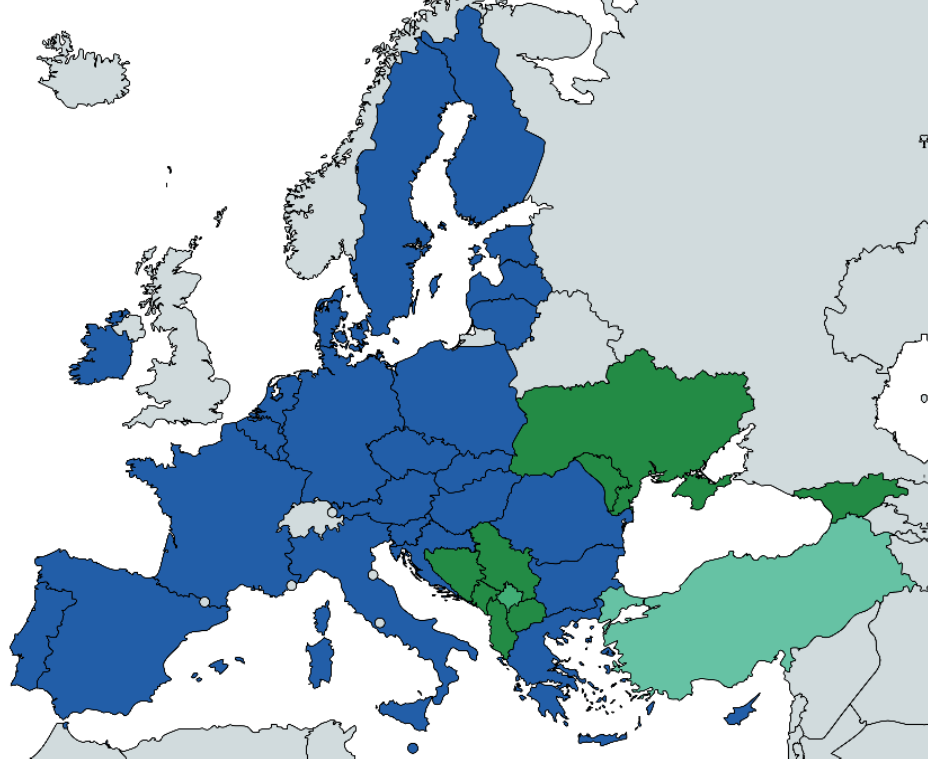
Candidate Countries for EU Accession:
- North Macedonia – received candidate status in 2005
- Montenegro – in 2010
- Serbia – in 2012
- Albania – in 2014
- Bosnia and Herzegovina – in 2022
- Ukraine – received candidate status on June 23, 2022
- Moldova – on June 22, 2022
- Georgia – the European Commission recommended granting candidate status on November 8, 2023; officially granted by the European Council on December 14–15, 2023
- Kosovo – is considered a potential candidate country but has not yet officially received candidate status (applied in 2022)
2.11.1 IMPACTS ON COHESION POLICY
Future enlargements are not expected to have a major impact on the overall cohesion budget. However, under the European Commission’s July 2025 proposal, cohesion spending as a percentage of the 2028–34 EU budget is expected to decrease.
The accession of poorer countries will lower the average EU GDP per capita, leading some regions to move into less favorable eligibility categories, as their GDP per capita (as a % of EU average) rises.
This will result in reduced cohesion allocations for certain regions and member states.
Both a “small enlargement” and a “large enlargement” are expected to reduce national cohesion allocations by 15%–21% for some current member states.
The distribution of costs will depend on whether eligibility rules are revised. For example, if less weight is given to GDP per capita and more to other indicators (e.g., demographics, climate, economic dynamics), the impact could shift.
According to the 2024 High-Level Expert Report on the Future of Cohesion Policy, some funds could be reserved to offset negative effects of enlargement — for example, in border regions or areas affected by supply chain disruptions.
Changes to cohesion funding are not just bookkeeping — they affect the development potential of all regions.
The challenge is to strengthen regional cohesion without sacrificing solidarity with countries needing support.
What is the “2.3% of GDP” Rule?
This is a rule that limits the maximum amount a country can receive from Cohesion Policy funds (ERDF, ESF+, Cohesion Fund) in each seven-year Multiannual Financial Framework (MFF).
It states that no country can receive more than 2.3% of its GDP (on average per year) from cohesion resources.
It doesn’t matter how low the GDP per capita is or how great the country’s needs — funding is capped at 2.3% of its GDP (at current prices).
Why does this limit exist?
Two main reasons:
- Absorption Capacity – Countries with lower GDP often struggle to absorb large amounts of funding in a short time.
- Budgetary Balance – Without a cap, poorer countries could absorb a disproportionate share of the EU budget.
What is the practical effect of the rule?
It prevents low-GDP countries from receiving very high levels of funding — even when they would qualify for more under the “Berlin formula.”
Examples:
Bulgaria, Croatia, Romania, and Greece have often hit the limit.
For Ukraine, due to its very low nominal GDP, this rule significantly restricts the funding it could receive — despite its massive reconstruction needs.
Why is this a problem for the Western Balkans & Ukraine?
These nine candidate countries have very low GDPs. So, the 2.3% rule results in low per capita funding, even lower than past enlargement waves (e.g. Poland, Hungary, Czechia).
This makes accession fiscally unattractive.
Many therefore propose:
- Temporary lifting of the 2.3% cap
- Raising it to 4% (as it was in 2000–2006)
- Special regime for Ukraine
For Greek audiences:
The revision of the CAP affects not only Ukraine but all EU farmers, food production, incomes, and the agri-food sector.
A progressive approach seeks fair redistribution, not cuts that harm small and medium-sized producers.
Summary:
The 2.3% GDP cap means an EU country cannot receive more than 2.3% of its GDP annually in Cohesion Policy funding — regardless of its needs.
This creates a ceiling on funding, even for countries with real needs and ready projects.
For SouthEast Europe countries, this means the EU must adopt fairer rules that consider actual needs, not just numerical limits.
If new member states do not gain full access to direct payments under CAP immediately (as in previous enlargements), and if they pay into the EU budget from year one, some could end up in a worse fiscal position after accession.
In such cases, temporary fiscal compensations should be included in the Accession Treaties, as in past enlargements (e.g., Iberian and Eastern Europe), such as:
- Exemption from national contributions to the EU budget for the first years
- Raising the 2.3% cap for new member states
A temporary increase to 4% (as in 2000–2006) is a potential solution — but requires strict absorption monitoring.
The accession of Ukraine inevitably requires a thorough review of coherence across EU funding sources for its reconstruction. It’s vital to avoid double-funding or substitution of grants, as seen during parallel use of RRF (Recovery Fund) and Cohesion Funds.
2.11.2 IMPACTS ON THE COMMON AGRICULTURAL POLICY (CAP)
Ukraine’s accession will bring major challenges for the CAP.
If the current CAP budget is maintained and comparable payments are made to new members (even slightly lower), all current member states would face a ~15% cut in their national allocations.
With a proposed €90 billion cut to the 2028–34 CAP budget, national allocations may be reduced by over 25%, assuming all else remains equal.
These forecasts intensify resistance to enlargement. Current global conditions — tariff wars, failed WTO talks, farmer protests, low food prices, and war effects — make the European Commission’s proposed CAP cuts politically very difficult and facing justified opposition.
Potential Solutions:
- Gradual (phased-in) accession stages for new members
- As in past enlargements
- Allows time for both the EU and candidate countries to adjust
- But merely delays the cost
- Less favorable access terms for new members
- Used in 2004–2013
- Not sustainable — new countries push for equal treatment
- Revision of Pillar 1 CAP criteria
- Ongoing discussions propose:
- More targeted support for small/medium farmers (mainly in Southern Europe)
- Less for large agro-businesses (mainly in Northern countries)
- However, this doesn’t affect allocation between countries
- Ongoing discussions propose:
- New allocation method for CAP Pillar 1
- Proposal to base allocation on land managed by small/medium farms
- Would significantly reduce Ukraine’s funding, but also harm countries with large-scale operations
- Mandatory national co-financing of CAP
- As done in cohesion policy
- Politically explosive
- Exclude Ukraine from CAP
- Not a realistic solution — would create unequal competition
- A phased-in approach would be more viable
General Observations:
If EU resources are not significantly increased and CAP/cohesion rules not revised, then:
- Total cohesion spending will gradually fall as EU-27 economies converge
- CAP + cohesion share of the budget will continue to shrink
- The total MFF will likely remain around 1% of EU GNI, as it has since 2000
- The Commission now proposes 1.26%
This leaves over €300 billion in “unallocated” funds — which will be a key negotiation point.
Some could be used to:
- Offset negative enlargement effects
- Maintain national CAP envelopes
- Compensate for major cuts due to Ukraine’s accession
Lifting the 2.3% GDP cap for enlargement countries may also be considered.
Given that the likely 2028–2034 MFF scenario is “no new enlargement”, resources freed by reduced CAP and cohesion allocations can be redirected to other priorities, as in the new EC proposal:
- Security
- Defense
- Competitiveness
- NGEU debt repayment
Final Note:
Enlargement is not a technical exercise — it’s a political choice about the kind of Europe we want:
A historical Europe of solidarity, development, and democracy from the Atlantic to the Urals —
or
A Europe of austerity, hard borders, fear, inequality, and militarization.
The progressive response is clear:
A more democratic, peaceful, and just Europe, with more common resources for CAP and Cohesion, not fewer.
BIBLIOGRAPHY
OFFICIAL REPORTS AND DOC. OF EU
- European Commission (2025). Enlargement Strategy and Reports.
- European Commission (2024). Report of the High-Level Group on the Future of Cohesion Policy.
- European Commission (2021). EU Border Regions: Living Labs of European Integration (COM(2021)393).
- European Commission (2020). Economic & Investment Plan for the Western Balkans 2021-27.
- European Commission (2023) Communication on EU Enlargement Policy
- DG REGIO (2022–2024). Interreg Evaluation Reports & EGTC Monitoring Reports.
- DG NEAR (2018–2024). annual country reports for Western Balkans & Turkey.
- EU-Western Balkans Summit Thessaloniki 2003, Declaration
- EU–Turkey Association Council (1995–2023). Customs Union updates.
- European Court of Auditors (2022). EU support for the rule of law in the Western Balkans.Β. INTERNATIONAL ORGANISATIONS
- World Bank (2024). World Governance Indicators (WGI).
- UNDP (2022). Human Development Report – South Eastern Europe Analysis.
- OECD (2021). Territorial Governance and Cross-Border Cooperation.
- Transparency International (2024). Corruption Perceptions Index.
SCIENTIFIC LITERATURE - Bieber, F. & Kmezić, M. (2020). The Crisis of Democracy in the Western Balkans. Routledge.
- Papadimitriou, D. & Gateva, E. (2022). EU Enlargement and the Western Balkans: The Political Economy of Integration. Palgrave.
- Anastasakis, O. (2019). Europe and the Balkans: A Troubled Relationship. Oxford SEESOX.
- Gynther, T. (2021). EU Conditionality and Governance Reform in the Western Balkans. Springer.
-
Ioannis Armakolas, Nicola Dimitrov, Isabelle Ioannides, Zoran Nechev, Oana Popescu-Zamfir and Valdova Zeneli (2024) EU Enlargement to the Western Balkans: Where there is a will, there is a way
- Jacques Delors Institute for EU Budget, 2025: Adapting the EU Budget to make it fit for the purpose of future enlargements