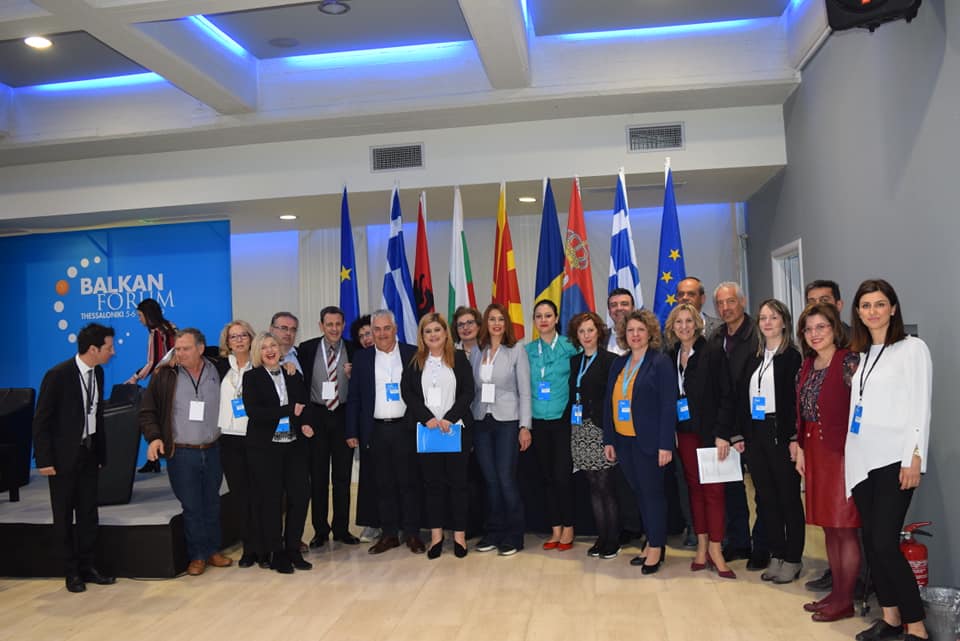
The establishment of the Balkan Forum in 2019, initiated by the Ministry of Macedonia and Thrace and co-organized with academic, scientific and socio-economic stakeholders, represented one of Greece’s most significant initiatives of the last decade for strengthening cooperation in the Balkans.
The Forum was conceived as a flexible, multidisciplinary and transnational platform of public diplomacy, aiming to mobilize governments, regions, chambers of commerce, businesses, universities, youth organizations and civil society actors towards the development of a new narrative of regional convergence and cohesion within the European framework.
Its creation stemmed from the consultation process of the Ministry’s Master Plan 2018–2028, which identified the strategic role of the Ministry of Macedonia and Thrace, the Interreg Managing Authority based in Thessaloniki, and the institutions of Northern Greece in promoting transnational and interregional cooperation across the Balkans. Its objective was to strengthen common cultural, environmental, tourism and trade routes and partnerships throughout the Balkans and Southeast Europe.
Since 2019, the Balkan Forum has evolved into a recognized regional platform with an annual presence and continuously expanding thematic scope, connecting Thessaloniki with the Western Balkans, the Eastern Mediterranean and the broader Southeast European region.
Mission of the Balkan Forum
The Forum operates through four complementary dimensions:
a) Economic, Productive and Business Innovation Cooperation
Promotion of networking initiatives, clusters and thematic partnerships in blue economy, agri-food, logistics, innovation, connectivity and cross-border environmental and cultural routes.
b) Institutional Convergence and Good Governance
A mechanism for exchanging know-how and best practices in public administration, environmental policy, digital transformation and the green transition.
c) Civil Society and Human Capital
A platform for empowering youth, universities, civil society organizations and creative ecosystems.
d) Culture and Tourism as Instruments of Public Diplomacy
Strengthening connectivity among the peoples of the region through cultural exchanges, collective memory and shared narratives.
Annual Balkan Forums (2019–2025): Themes and Milestones
Balkan Forum 2019
“Thessaloniki as a Hub of Cooperation in Southeast Europe”
5–6 April 2019, HELEXPO, Thessaloniki
Main themes:
- Balkan economic integration
- Regional development and infrastructure
- Digital convergence
- Cross-border cooperation and Interreg
- The role of universities in the Balkans
Achievement: Establishment of the Forum as a permanent mechanism for dialogue and cooperation.
Balkan Forum 2020
“Entrepreneurship and Innovation”
25–26 September 2020
Main themes:
- Entrepreneurship and innovation policies in the Balkans
- Business and technological networking
- Design of Interreg programmes for the 2021–2027 period
- Integration of innovative practices and interdisciplinary cooperation
- Green entrepreneurship, circular economy and climate action
- Post-pandemic regional economic reconstruction
Balkan Forum 2021
“Sustainable Development of the Balkans in the Post-COVID Era”
24–25 September 2021
Main themes:
- Cross-border Green Deal initiatives
- Smart tourism and agri-food cooperation
- Innovation and new technologies
- Cohesion policies and development instruments
- Youth entrepreneurship
- Brain drain and brain regain
- Digital learning
- Balkan university networks
- Social economy
Balkan Forum 2022
“Sustainable Development & Connectivity – Digital Transformation, Networking and Convergence in the Balkans”
5 October 2022
Main themes:
- Digital transformation of business ecosystems
- Digital transformation of public and regional authorities
- Digital networking among academic institutions
- Transport connectivity (TEN-T and Balkan corridors)
- Sustainable tourism routes
- Agri-food and gastronomy policies
- Water and natural resources management
- Cultural routes across the Balkans
Balkan Forum 2024
“Energy Cooperation in the Balkans”
Balkan Forum 2025
“Entrepreneurship – Sustainable Tourism – Challenges, Prospects and Opportunities in the Balkans”
13 June 2025
Main themes:
- Entrepreneurship as a driver of Balkan development
- Business environment, opportunities and transnational cooperation
- Sustainable tourism policies and innovation
- Environment and tourism towards sustainable development
- SME development models
Where Does the Balkan Forum Stand Today? (2026)
Today, the Forum could function as:
- A regional hub for programming and technical cooperation
- A platform aligned with European strategies
- A mechanism connected to:
- EUSAIR
- The Prespa Master Plan
- Interreg Programmes
- A Greek soft-power instrument
The Forum promotes Greece, and particularly Thessaloniki, as a regional center of dialogue, connectivity, cooperation and stability in the Balkans and Southeast Europe.
Future Potential
The Balkan Forum could evolve through the expansion of its Steering Committee to include partners from all Balkan countries and through a rotational hosting system.
1. A Regional Think & Do Tank for the Balkans
A permanent hub for data, policy dialogue and cooperation in:
- Economy and trade
- Environment
- Culture
- Youth policies
It could continue supporting cooperation among the seventeen institutions involved in implementing the Prespa Cross-Border Master Plan while promoting new initiatives related to mountain ranges, rivers and maritime corridors across Southeast Europe.
2. A Supporting Mechanism for Macro-Regional Strategies (EUSAIR and MED)
Through:
- European Groupings of Territorial Cooperation (EGTCs)
- Thematic interregional working groups
- Flagship projects
- Joint programmes and initiatives
3. A Bridge Linking Greece, the Balkans and the Eastern Mediterranean
Particularly in the fields of:
- Green energy
- Transport
- Mediterranean diet
-
Blue and Green Skills Partnerships
- Civil protection
- Culture and tourism
- Strengthening the international role of HELEXPO
- Digital governance
-
Thessaloniki and Greek cities as hubs on innovation networks
Conclusion
The Balkan Forum represents a contemporary Greek contribution to regional integration, demonstrating that cooperation in Southeast Europe should not be confined to intergovernmental institutions alone but can also be fostered through flexible, participatory and multi-thematic platforms.
As the Balkans increasingly emerge as a strategic region for peace, stability and green growth within the European Union, the Balkan Forum has the potential to become a distinctive institution of Greek inspiration and regional significance—a platform that advances the European vision of regional convergence in an inclusive, progressive and sustainable manner throughout the Balkans and Southeast Europe.
For more information: https://balkanforumthess.mathra.gr/