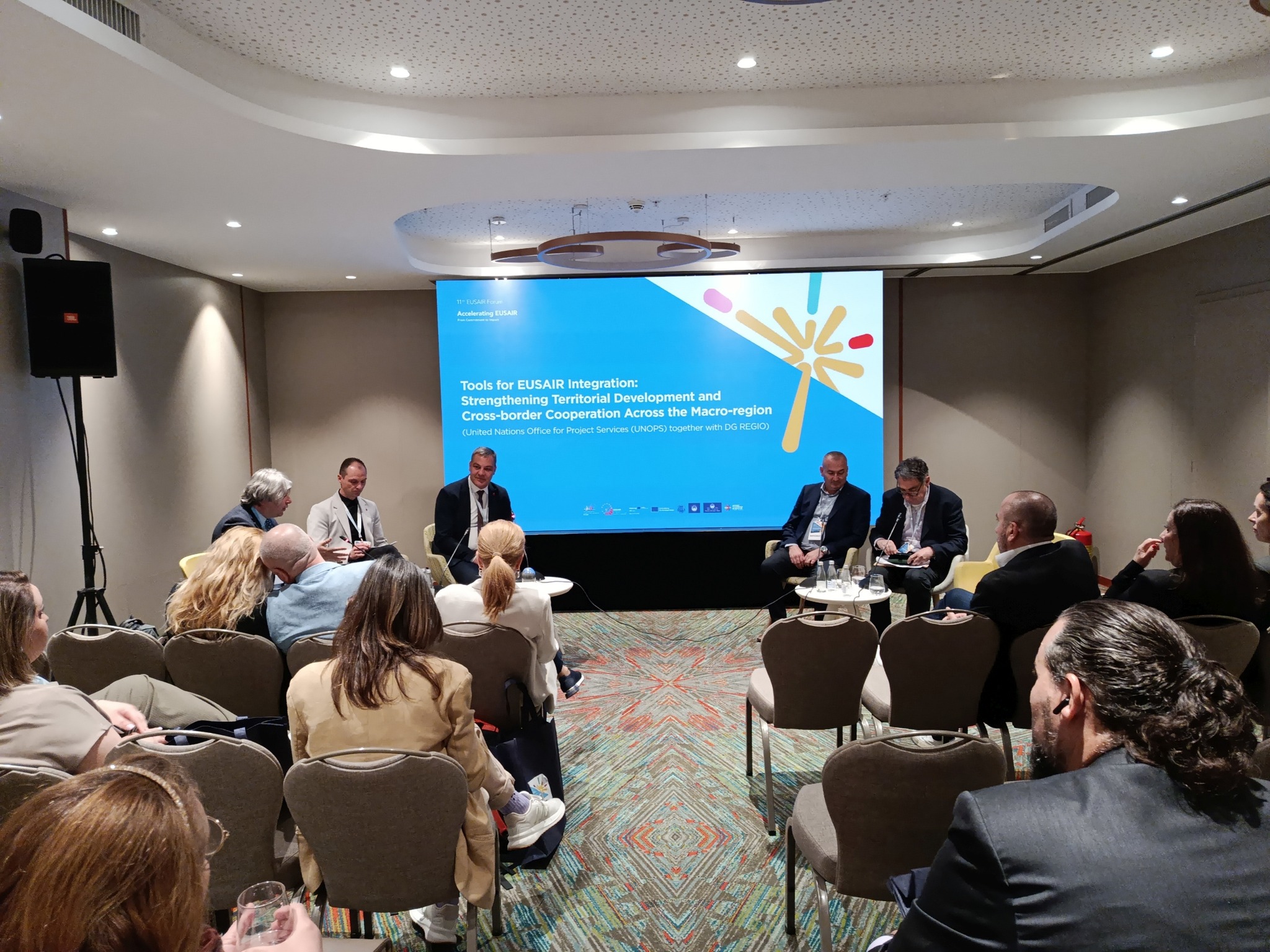
At the 11th EUSAIR Annual Forum in Skopje on May 2026, Prespa was presented as one of the three EUSAIR flagship initiatives in the session on strengthening territorial development and cross-border cooperation in the Adriatic–Ionian macro-region. This is important because it places Prespa on the map as a potential model for how cross-border areas can move from isolated projects to permanent, institutional cooperation.
The four neighboring municipalities of Prespa — Prespes, Resen, Pustec and Devoll — took part in a discussion moderated by Gilles Kittel from DG REGIO and spoke with one voice: Prespa must be treated as a single area. Four municipalities, three countries, two lakes, but also a shared set of challenges: climate change, biodiversity loss, pressure on water resources, demographic decline and youth outmigration. The response, therefore, cannot be fragmented or confined within the borders of each country.
The real challenge is institutional. For more than twenty years, cooperation in Prespa has relied mainly on bilateral European projects: Greece–Albania, Greece–North Macedonia or Albania–North Macedonia. These have been useful projects, often with significant results, but almost always within a bilateral framework and often without continuity. This model has now reached its limits.
The response proposed through EUSAIR’s Cross-Pillar Flagship has two complementary strands. On the one hand, Prespa is one of the areas approved to participate in the IMPACT initiative, with the support of the OECD, with the aim of preparing a single cross-border CLLD strategy for the four municipalities, looking ahead to the 2028–2034 programming period. On the other hand, the European Grouping of Territorial Cooperation, the EGTC, can give this strategy legal and operational substance: shared staff, joint contracts, resource management and the capacity to function as a stable implementation mechanism for the entire cross-border area.
Five pillars have been selected to give substance to this transition. First, sustainable tourism, with Prespa promoted as a single destination rather than three separate parts valorising the new border crossing currently under construction with financing from the Interreg CBC Greece-North Macedonia Programme. Second, agri-food, which can connect the area’s key products with gastronomy, local identity and visitor appeal. Third, cross-border water management and environmental protection, because the lakes and ecosystems cannot be protected through three different approaches. Fourth, youth and entrepreneurship, as a response to ageing, isolation and outmigration. And fifth, as a horizontal axis, cross-border governance itself: in other words, the way in which the municipalities, institutions and communities of Prespa will be able to plan and act together, consistently rather than opportunistically.
The journey already has a starting point. The Memorandum of Cooperation among the four Mayors was signed in Laimos in November 2024, while the national approvals for the creation of the Prespa EGTC in Greece, Albania and North Macedonia are expected to move forward in 2026. This is the critical next step: turning political will into institutional capacity.
Three countries, two lakes, one future for Prespa. If this cooperation takes on a permanent form, it can serve as a practical, living example of how Southeast Europe — and especially areas at the interface between the EU and pre-accession countries — can turn borders from dividing lines into bridges of shared prosperity.
Δείτε λιγότερα