
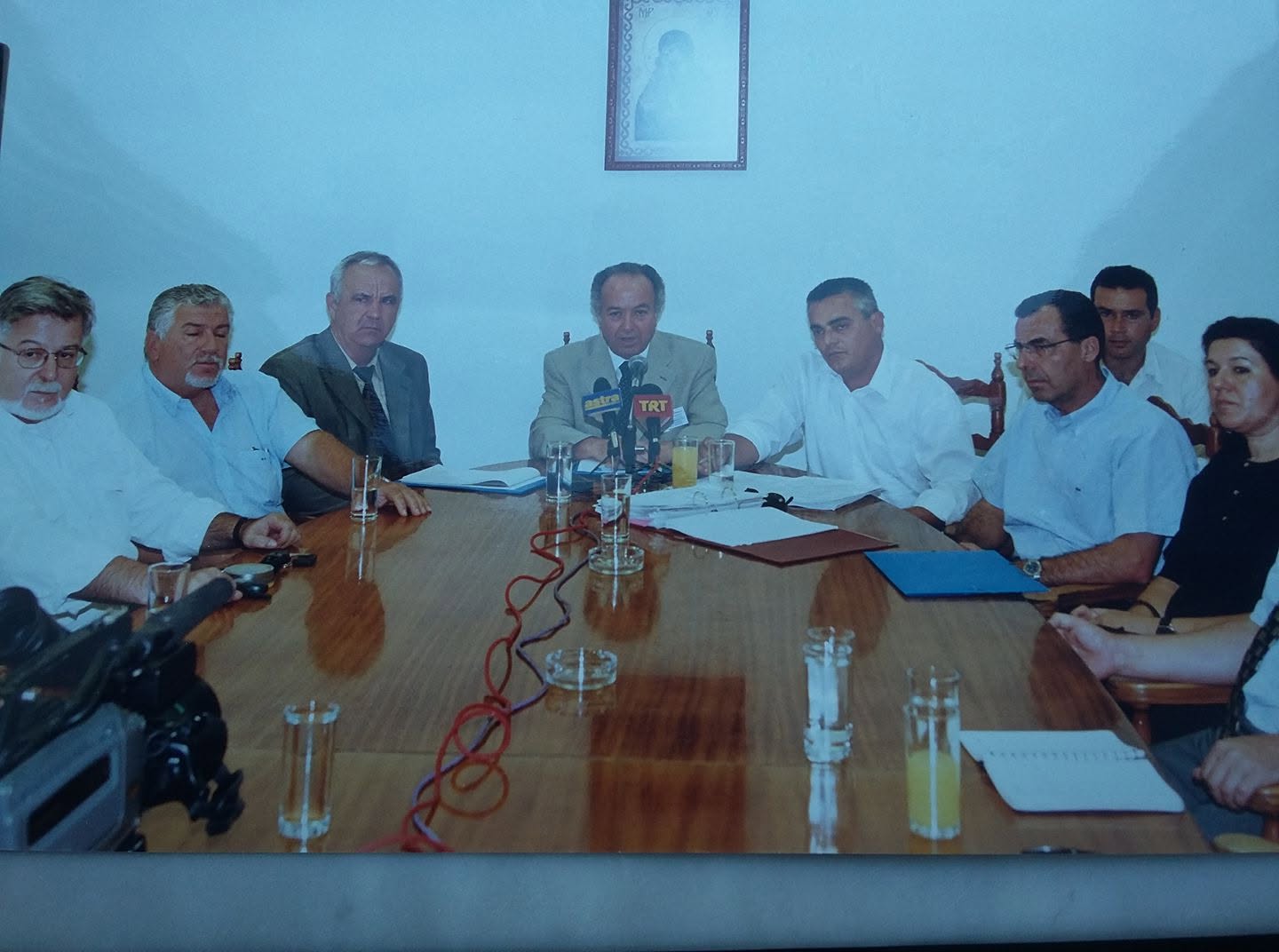
Photo from the meeting of representatives of the Panhellenic Coordinating Committee for the Recognition of Feta in Elassona, 2002.
35 GREEK ORGANIZATIONS NOTE ON 17/4/2017 FOR THE FULL PROTECTION OF THE GREEK PDO FETA CHEESE IN CETA, EU-SADC AND IN ALL BILATERAL TRADE AGREEMENTS BETWEEN THE EU AND ITS MAIN TRADE PARTNERS TO FOLLOW.
According to data from ELSTAT / Eurostat, IRI and the Journal of “Food and Beverage” of 2014, the Feta cheese industry in our country employs 100,000 shepherds, who are grazing 12 million sheep and goats in the Greek countryside and an estimated 400,000 workers in the dairy / cheese industries and their related services. In total, more that 120,000 tonnes of feta cheese are produced per year in 500 cheese producing facilities. Greece’s annual exports of feta cheese, which are growing steadily, amount to 45,000 tonnes, sold in 56 countries and five continents, grossing a turnover of 260 million € per year. However, Greece produces and distributes only 28% of the cheese marketed as Feta in the world. This means that 72% of the global distribution of cheeses named Feta is covered by mass produced imitation Feta cheese products, which in the majority of cases are totally different than the authentic Greek Feta, as they are produced mainly from assembly line barn raised cows in the USA, Canada, S. Africa, Australia N.Z. etc.. Additionally, they are fed with inferior quality commercial feeds and are injected with dangerous hormones and antibiotics.
It is this excess global demand of about 400,000 tonnes of imitation Feta, grossing more than a billion Euros a year, which causes so much conflict in the world markets between the authentic Greek Feta cheese Product Designation of Origin (PDO) producers and their numerous usurpers, who are marketing gross imitations of our authentic Greek PDO by exploiting its most valuable Intellectual Property Rights (IPRs) and its corresponding commendable market value.
The effort for the protection of Feta cheese in the EU went through several stages but finally in 2002 it was successfully registered by the European Commission (EC) as an EU PDO (regulation 1829/2002).
The EC has been granted the authority to negotiate bilateral free trade agreements, between the EU and its main trade partners, on behalf of the Council of EU Ministers, a
s envisaged in the 2009 Lisbon Treaty. After the collapse of the multilateral negotiations of the Doha Round in 2008, within the WTO framework, the EU opted to start negotiating bilateral trade agreements with its main partners, as Korea, 6 countries of Central America, Peru – Colombia & Ecuador, Canada, Singapore, Ukraine, Moldova, Georgia, Japan, USA, 15 countries of the S. African Development Community (SADC), 6 Latin American countries (MERCOSUR), Vietnam, Mexico, Australia, N. Zealand, Thailand, the Philippines, Indonesia and Turkey,
As far as Feta cheese in concerned, the illicit trade of “counterfeit” white cheese products made from cow’s milk, produced from low-cost and low quality commercial feeds, is dominant in all of the above EU trade partner countries. For example in Canada, 90% of the 3.500 tons of Feta labelled cheeses consumed yearly are gross imitations of Feta, competing side by side with the authentic Greek PDO, which is imported from Greece.
The EU-Canada CETA Agreement grants full protection to 145 EU PDOs in Canada, including to the two famous EU cheeses Parmegiano Reggiano and Roquefort, prohibiting, therefore, any distributers, big or small, from marketing any homonymous imitation cheeses in this market. Unfortunately, on the contrary, our flagship PDO Feta cheese, 5th in economic importance amongst 3000 EU PDOs, not only was not granted any worthwhile protection but for the first time in the history of EU bilateral trade Agreements, a most preferred Trade Partner, Canada, demanded from the most vulnerable EU m-s, Greece, to accept unfair competition against its most valuable PDO “Feta cheese” in its market, with the tolerance of our authorised negotiators, the EC. In short, all pre-existing homonymous to Feta imitation cheese products in the Canadian market, will continue to be sold side by side with our renowned PDO, in eternity. We are wondering, why Greece received such discriminatory treatment from Canada and why the EC did not protest regarding such bold and unethical request from such preferred trade partner of the EU? The multilateral rule of “fair competition” amongst trade partners is probably the most highly respected market economy rule in the world. Due to such unfair and discriminatory treatment against Greece in this Agreement, we are wondering about our legal rights, both in bilateral (Greece – EU / Greece – Canada) and multilateral context.
As if the catastrophic results of the CETA negotiations were not enough for our flagship PDO, the EC proceeded to secure us the same discriminatory results in the EU-SADC EPA Agreement, despite our timely protracted complaints. This time the results were even more discriminatory against us, as Feta cheese was singled out as the only EU PDO amongst 251, which did not receive any protection in the EU-SADC Agreement. Again, we are wondering why Greece, the most vulnerable link in the EU family of m-s, deserves such an unfair and discriminatory treatment regarding its most valuable PDO ‘Feta” in this Agreement? It is obvious that the unprecedented negotiation results of CETA have become a bad precedent to be repeated in the results of most of future EU bilateral trade Agreements. So, why has the EC treated us so unfairly and unequally compared to the rest of the EU m-s? With such long history of production, why should we accept such unfair and unethical demands from those who claim that they wish to be the EU’s most preferred trade partners?
The Commission presented us with two conciliatory Declarations, supposedly acknowledging that the results of the negotiations in the above two Agreements are not the most ambitious regarding the protection of our flagship PDO Feta cheese and due to that, they would try to improve such results in the future. In short, these two Declarations have no legal effect what so ever, as they don’t include the EU’s two other trade partners, Canada and S. Africa, and they are not annexed to the two Agreements. So, these two declarations are nothing but a cover up of a damaging conciliatory policy by the Greek Government.
Basically, these trade Agreements are legitimising – with the stamp and the signature of the European Commission, the European Parliament, as well as the Greek Government – the current unfair competition imposed against Feta, by white cheeses produced by multinational companies, which will continue to speculate abusively in the global market, exploiting the name and the Intellectual Property Rights (IPRs) of feta cheese.
If feta cheese was protected in the markets of the 16 countries with which the EU is currently negotiating trade Agreements, all the counterfeit Feta imitation products would have been forced to change denominations, setting the stage for Feta cheese to reach the market value that it deserves, which should be more than double of today’s prices. Such development would trigger an increase in demand and therefore of Feta production, along with a resulting rise in employment and related economic activities. Furthermore, if such prospects are combined with the promotion of the rest of 21 PDO Greek cheeses, there would be substantial growth in the sector in general, which in turn could jump start the ailing Greek economy as a whole..
Therefore, it is important to link this effort with the formation of a feta cheese consortium, which along with the help of European agri-food aid programmes and the timely engagement of agri-friendly consumer movements, could revive and save the sector.
At a time when our country, after seven years of crisis and numerous austerity programs, is struggling to recover and to return to a path of sustainable development, it is suicidal to accept such discriminatory treatment against our emblematic PDO feta cheese, our principal strategic agri export product, associated with the traditional and cultural identity of our country.
The acceptance of the proposed results of the negotiations of the CETA and EU-SADC Agreements, which equate our authentic Greek PDO with all kinds of counterfeit low quality white cheeses, would be catastrophic for our renowned the word over genuine product and will cause disastrous consequences for the livestock and cheese industry in our country.
EU PDO products distributed in the markets of our most favoured EU trade partners are not simple products offered for speculation; they are sensitive public goods, because they embody the traditional mode of production, the biodiversity and the culture of the local communities where they are produced.
We defend the EU acquis, which registered feta cheese as a PDO product and in parity with equally important EU cheese PDOs, the EU’s principles for fair trade and fair competition, along with those of the right to preference and the right of the consumers to be well informed so they could make the right choices.
We call on the members of the Greek National Parliament, by using our ancient Greek virtues of justice and ethnic conscience & pride, to reject the EU-SADC and CETA discriminatory Agreements, as such, when they come to our Parliament for adaption, until these two EU supposedly most preferred trade partners, grant us equal and similar protection for our PDO Feta cheese, as they have granted to all other EU m-s. Additionally, our Parliament’s veto of these two catastrophic for us Agreements, would teach the EC a lesson, so that in the future it would treat all m-s equally and fairly and would make sure to achieve the protection of our flagship PDO, feta cheese, in all international trade agreements between the EU and its trade partners, enforcing, therefore, the productive, environmental and social quality standards in Europe, according to the EU acquis.
We submit herewith a draft Decision of the Greek Parliament for the full protection of feta cheese as a PDO product in the CETA and EU-SADC trade Agreements, as well as in all future EU bilateral trade agreements to be negotiated.
Consequently, if such unprecedented and unfair negotiation results for our flagship PDO, by the EC, in the above mentioned agreements are not challenged by the Greek people’s representatives in the National Parliament, they will prove catastrophic for our flagship PDO and our overall endangered agrifood sector.
We co-sign the Proposal to the Parliament and to the European Commission,
1)Region of Thessaly
2) Region of W. Macedonia
3) Federation of shepherd Farmers of Thessaly
4) Association of Cheese Producers Larissa
5) Pan-Hellenic Association of Breeders
6) SEVGAP
7) Stop ttip, ceta, tisa
8) Greek Friends of Nature
9) Agricultural Association of Cereals & Livestock Products Kastorias
10) Organic Management of Products, By-products & Outputs Feta PDO
11) Agricultural Dairy Cooperative of Kalavrita
12) Municipality of Larissa
13) Municipality of Tirnavos
14) Financial Chamber of Larissa
15) NGO Volunteer NGO Network of Thessaly
16) Thessalian Citizens of the World for Sustainable Development
17) Ecological Thessaly
18) Association of Young Farmers of Larissa
19) Terpsithea Local Council
20) Almyros Environmental Initiative ‘In Action’
21) Elassona’s Perevia Network
22) Friends of the Institute of N. Poulantzas
23) Active Citizens of Larissa
24) Union of Writers of Larissa
25) Association of Organic Farmers of Thessaly
26) Aegilopas, Magnesia Biodiversity Network
27) Vineyard Professionals Association
28) Common ngo Trikala
29) Oikosfera ngo
30) Traversing Streets of Thessaly
31) Friends of Earth-Trikala
32) Panhellenic Association of Young Farmers – Thessaly
33) Ecological management of Feta products
34) GEOTECHNICAL CHAMBER OF GREECE / GEOTEE
7/4/2017
Coordinator of the Greek Committee for FETA: Georgios Emmanouil, thessgeor@yahoo.gr
RESPONSE OF EUROPEAN COMMISSION
DIRECTORATE-GENERAL FOR AGRICULTURE AND RURAL DEVELOPMENT
Directorate A. International Ref. Ares(2017)2595730 – 22/05/2017
Director
Brussels,
A1/DN D(2017)2900165
Dear Mr Emmanouil,
Thank you for your email sent on 3 May 2017 to Mr Vassilakis, where you have expressed
concerns of Greek producers of “Feta” cheese in light of the entry into force of EU trade
agreements with Canada (CETA) and Southern African countries (SADC EPA). Let me
address each of these concerns in turn.
Status of Feta in EU trade agreements: in substance, you allege that in the trade
agreements concluded by the European Union, “Feta” was the only protected designation of
origin (PDO) regarding cheeses that did not benefit from a full protection.
Please note in this connection that while there are circa 3400 geographical indications
currently protected at EU level, among which 232 cheeses, the protection of “Feta” has
systematically been sought in the EU’s international agreements, even where only a restricted
list of geographical indications was submitted to our negotiating partners.
The full protection of “Feta” has already been achieved in most neighbourhood countries
with whom the EU has concluded an international agreement (e.g. Bosnia-Herzegovina,
Serbia, Montenegro, Switzerland, Moldova, Georgia, Armenia, Ukraine, etc…), as well as in
Korea. Such a full protection of “Feta” has equally been secured in a series of agreements
that have not yet entered into force (e.g. with Morocco or Iceland).
The Commission is further committed to achieving the best possible level of protection in
respect of the flagship PDO “Feta” in all ongoing or future agreements.
Feta protection in CETA and SADC EPA: you consider in essence that the lesser
protection granted to the designation PDO “Feta” in Canada and South Africa is not justified
by the limited production of cheese bearing such name in these two countries, and that “Feta”
is unduly discriminated as compared to PDOs from other Member States.
The protection of intellectual property rights is governed by the principle of territoriality, and
is subject to the concrete market situation prevailing in the country concerned.
Within the EU, the designation “Feta” was registered by the Commission as a PDO by virtue
of Regulation (EC) No 1829/2002, following an extremely difficult 8-year process that led to
11 judicial proceedings in front of the European Court of Justice. It was established in this
framework that in Greece itself, the compulsory milk composition of “Feta” was defined in
1987, the corresponding geographical area delimited in 1988 and its formal protection as a
PDO enshrined in 1994.
Mr Giorgos Emmanouil
thessgeor@yahoo.gr
Commission européenne/Europese Commissie, 1049 Bruxelles/Brussel, BELGIQUE/BELGIË – Tel. +32 22991111
The late protection of “Feta” in its country of origin coupled with the lack of historic care
taken by interested parties to protect such designation in third countries, enabled natural or
legal persons in Canada and South Africa to produce and/or market for decades a non
originating cheese under such designation “Feta” that incidentally does not refer to a
geographical place, and which gradually acquired in these two countries a quasi-generic
character.
Pursuant to international rules, in particular Article 24.4 of the TRIPS agreement, the
grandfathering of such prior uses may not be discarded.
Yet, the agreements concluded with Canada and SADC EPA States paved the way for a
significantly fairer competition. The alternative would have been to maintain the status quo,
meaning no specific protection at all for “Feta”.
In the agreements with Canada and South Africa, Feta is accordingly protected and
recognised as a Greek GI, thus definitively preventing it from becoming generic; the
agreement imposes further labelling restrictions and requirements on the non-originating
product (i.e. an obligation to refer to the actual country of origin and to the milk
composition, a prohibition to use Greek flags, images and any other devices invoking the
Greek terroir; the addition of the term “style” or “type”…), which allow henceforth the
consumer to easily distinguish the genuine product, contrary to the situation prevailing prior
to this agreement.
The difference of treatment you invoke as compared to the full protection of other EU PDOs
is due to the fact that in Canada and South Africa, there was no identified prior use nor any
related genericness claims made in respect of them. As regards Canada, there were four other
EU GI, also cheeses, in the very same situation than Feta and which, accordingly, will enjoy
the same level of protection in Canada that Feta will.
Commitment to enhance protection of Feta: you consider that the Commission has not
formally committed to seek a future improvement of the protected status of “Feta” in South
Africa and in Canada.
The Commission has repeatedly committed to use the appropriate mechanisms contemplated
in these agreements with a view to further increase the level of protection granted to the
name “Feta”; such commitment has been made inter alia in official declarations of the
Commission, as well as in replies of Commissioner Hogan, on behalf of the Commission, to
parliamentary written questions P-004696/2016 and P-004719/20162.
In this respect, a key element that would facilitate such enhanced protection is the education
of non-EU consumers about the origin and quality of the PDO “Feta”, allowing the
consumers of our negotiating partners to fully grasp the unique specificities of the authentic
product; thus, the Commission indicated in its aforementioned declarations that it will offer
its continuous support to Member States, producers and exporters of geographical indications
in order to promote their geographical indications; in this connection, an extensive dedicated
workshop has already been held on 11 July 2016 in Athens.
I hope the explanations above have proven helpful.
Yours sincerely,
2
John A. CLARKE
Electronically signed on 22/05/2017 08:51 (UTC+02) in accordance with article 4.2 (Validity of electronic documents) of Commission Decision 2004/563