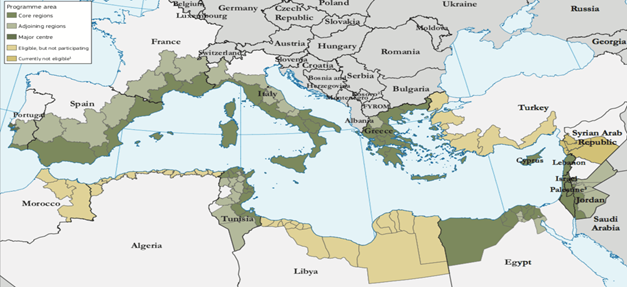
Μap of EU Interreg Programme ΕΝΙ/Νext Med
Between Support, Weak Diplomacy, and the Need for a New Peaceful Vision
The European Union has long been the most significant non-military stabilizing actor in the Middle East. In a region marked by armed conflicts, human tragedies, geopolitical tensions, and geostrategic rivalries, the EU has built a model of engagement based on economic support, humanitarian aid, institution-building, and international law.
Although often underestimated in international public debate, its contribution represents the clearest example of “soft power” in a region frequently dominated by military logic.
1. ENI – NDICI / Global Europe and NEXT MED: Pillars of Peace and Development
1.1 ENI (European Neighbourhood Instrument) and its successor NDICI–Global Europe
With a budget exceeding €17 billion during 2014–2020 (ENI) and €79.5 billion during 2021–2027 (NDICI–Global Europe), the EU’s financial architecture for its neighbourhood has supported:
- institution building,
- health services and infrastructure,
- strengthening civil society,
- actions for refugees, youth, women, NGOs, and local authorities,
- energy and climate transition.
In Palestine in particular, these funds support essential public functions, health and education services, municipal operations, and the salaries of public employees of the Palestinian Authority.
1.2 The NEXT MED Programme (formerly ENI CBC Med) – Europe Cooperates from Below
Through ENI CBC Med (2007–2020) and now NEXT MED 2021–2027, the EU has funded hundreds of local and regional cooperation projects in:
- green economy and sustainable energy,
- startup support,
- empowerment of women and youth,
- sustainable tourism and cultural heritage,
- local government and social services,
- water and waste management.
In Gaza and the West Bank, NEXT MED projects support:
- social entrepreneurship,
- recycling and circular economy,
- low-cost energy solutions,
- youth digital skills training,
- access to clean water and micro-enterprise development.
This “quiet diplomacy” may not make headlines, but it shapes everyday life and gives hope to thousands of people.
It is especially significant that in NEXT MED 2021–2027, Palestine and Lebanon participate alongside Israel in common projects, while Turkey and Cyprus also cooperate, despite Turkey’s official non-recognition of Cyprus.
1.3 Support for the Palestinian Authority – The EU as the Largest Donor
The European Union is the largest international donor to the Palestinian Authority, mainly through UNRWA, ECHO, and NDICI, providing over 70% of its external funding resources.
This includes:
- salaries for teachers and healthcare personnel,
- support for development structures,
- humanitarian aid in Gaza and the West Bank,
- funding for infrastructure and energy security projects,
- strengthening local authorities and civil society.
European funding seeks to preserve the operational and institutional viability of the Palestinian Authority, keeping alive the prospect of a two-state solution under the framework of the United Nations.
1.4 The EU and International Law: Commitment to UN Resolutions
The EU consistently supports the resolutions of the United Nations Security Council, especially regarding:
- the Palestinians’ right to self-determination,
- condemnation of settlement expansion,
- the two-state solution based on the 1967 borders,
- Jerusalem as the capital of two states,
- recognition that Gaza cannot remain under permanent blockade.
- the ongoing occupation of territory of the Republic of Cyprus by Turkey, which is unacceptable under international law
Unlike many other international actors, the EU has adopted a clear position based on respect for international law and human rights as prerequisites for peace.
1.5 From a Progressive Perspective: The Need for a More Independent and Active European Diplomacy in the Middle East
Despite its positive contributions, European policy in the Middle East often remains:
- defensive,
- weak,
- dependent on U.S. geopolitical priorities,
- behind developments shaped by war, occupation, and the absence of a political process.
From a progressive perspective, the region requires far more ambitious, peaceful, and multilateral European initiatives.
What Europe Needs to Do in the Coming Years
a. Take the lead in an international peace conference
No more waiting for U.S.-led “mediation” initiatives, which are either one-sided in favor of Israel or fail to progress.
b. Exert political pressure for an immediate end to violence in Gaza and settler violence in the West Bank
The EU must demand:
- immediate cessation of violence,
- unrestricted humanitarian access to Gaza,
- lifting of the blockade.
c. Substantively support the two-state solution
Not only through declarations, but through:
- recognition of the Palestinian State by all EU member states,
- clear distinction between Israel and occupied territories in product labeling and trade relations,
- legal use of international jurisdiction through the International Court of Justice and International Criminal Court.
d. Strengthen civil societies, universities, municipalities, and NGOs
The EU should reinforce democratic actors in Gaza and the West Bank, while also promoting cooperation between democratic Israeli institutions and Palestinian counterparts.
These local actors are the ones who can keep hope alive.
e. Pursue a truly balanced foreign policy
Europe must stop reproducing dependence on U.S.–Israeli strategic choices and instead promote multilateral cooperation based on international law and UN resolutions.
Conclusion: The EU as a Voice of Peace, Dignity, and Solidarity in the Middle East
The Middle East is a field where Europe can—and must—demonstrate that the world can function differently:
- with respect for life,
- with respect for international law,
- through multilateral cooperation,
- by investing in development instead of conflict,
- by restoring justice instead of perpetuating injustice,
- by promoting the vision of an East Mediterranean and Middle East free of nuclear weapons.
Europe’s strength is not military.
Its strength lies in cooperation, diplomacy, economic support, and peace.
That is the main role the peoples and citizens of the region expect from the EU—and it is the role that truly suits it.