-
A Moment of Strategic Realignment
The recent Greece–U.S. agreements mark both a sharp shift in Greek energy policy and a substantial contribution to the evolving European energy map.
The timing was revealing: three U.S. cabinet members arrived in Athens carrying an agenda of energy repositioning. At the same time, COP30 – the World Climate Conference held deep in the Brazilian Amazon – was bringing together most of the international community, which continues to argue that hydrocarbon extraction must come to an end.
Greece is now required to operate on multiple levels simultaneously. It is strengthening its geopolitical role, yet it is also becoming part of a network of alliances and strategic demands that require maximum strategic foresight and coherence.
-
The Transatlantic Energy System and Russia’s Relative Decline
By rapidly upgrading its infrastructure, Greece is emerging as Europe’s most critical southern gateway for U.S. Liquefied Natural Gas (LNG).
The Vertical Corridor linking Alexandroupolis (Greek city and port in the northeastern region of Thrace, near the Greek-Turkish border) to Ukraine – via Bulgaria, Romania and Moldova – is progressively replacing Russian gas flows and laying the foundations for a new, multi-layered security architecture.
Although Russian gas is retreating, Moscow still retains tools capable of generating disruption. Genuine energy independence will only be achieved when Europe – not just Greece – acquires sufficient storage capacity, interconnectivity and institutional resolve to prevent any strategic return of Russian gas to the market.
3. America’s Come Back and the New Extraction Doctrine
Washington has re-entered the region as the most assertive strategic actor in the Eastern Mediterranean. With the return of President Trump, U.S. energy policy exhibits an unexpected continuity of intent: “Drill, baby, drill” – not merely as a slogan, but as a strategic compass.
Within this framework, Greece is being upgraded, but not in a neutral way. Cooperation with with the American energy company ExxonMobil in the Ionian Sea (in the west of Greece on the maritime border with Italy in the Adriatic Sea) and with the American energy company Chevron south of Crete (a large Greek island in the south of Greece on the maritime borders with Egypt and Libya in the Libyan Sea) aligns Greek energy choices directly with U.S. geopolitical and corporate priorities.
Regarding the Ionian, official statements clarify that exploratory drilling will be assessed within the next 1–2 years, while the probability that any future extraction proves economically viable remains low – estimated at only 15%–18%.
Meanwhile, American interest in seabed research in the zone between Libya and Crete carries a pronounced political dimension. U.S. diplomacy has already moved toward mediating between Greece and Libya, as well as between Egypt and Libya. These diplomatic channels revived the proposal for a regional Eastern Mediterranean Conference.
While the agreements unlock geopolitical momentum, they also raise a central question: Is Greece leveraging the opportunity as an autonomous strategic actor – or is it becoming a key instrument in the execution of the new U.S. energy geostrategy?
It must also be underlined that extraction activities on a non-delimited continental shelf are prohibited under International Law. Neither the continental shelf nor the Exclusive Economic Zone (EEZ) can be delimited unilaterally by Greece. An agreement with the state possessing opposite (or “adjacent/opposite”) coasts is mandatory. Therefore, dialogue with the internationally recognized Libyan government in Tripoli is not optional – it is the only legal and realistic path forward.
4.Europe’s Green Policy
European green policy has recently shown signs of inconsistency and oscillation. Nevertheless, despite the energy crisis triggered by Russia’s invasion of Ukraine, the shift in U.S. energy priorities, and the rise of far-right forces in Europe calling for a reversal of the green transition, the European Union remains formally committed to a non-fossil future: by 2050, it aims to eliminate all fossil fuels – not only coal and oil, but also natural gas.
From this perspective, Greece risks being perceived in certain EU circles as a country returning to fossil fuels. As the Eastern Mediterranean is already considered a global climate-crisis hot spot, Greece should have been positioning itself at the forefront of clean-energy leadership.
COP30 also highlights the widening global climate financing gap. Emerging economies still receive only a small fraction of the funds required for green transition – creating pressure on Europe as well, which is now expected to reconcile energy autonomy with environmental alignment.
-
Greece: Neither a Superpower nor a New “El Dorado”Greece is gaining status as a key node in the emerging European energy-security system, attracting investment interest, deterrence advantages and strategic leverage. Yet the same momentum carries risks: long-term dependence on U.S. LNG, potential price volatility, environmental pressures and greater exposure to hybrid threats.
Moreover, even if extraction projects advance over time – despite environmental concerns, particularly in tourism-sensitive regions –another strategic question arises: Where will this gas be sold, if Europe is structurally exiting fossil-fuel consumption?
Greece requires strategic cohesion and a deep understanding of Europe’s regulatory and geopolitical reality.
-
The Eastern Mediterranean Is Transforming in Real Time The wider region spanning Cyprus, Israel, Crete, and Libya is entering a period of exceptional strategic mobility.
The transfer of natural gas, electricity, hydrogen, and other energy forms from the Middle East, the Persian Gulf, the Arabian Sea and North Africa toward Europe increasingly passes through the Eastern Mediterranean. After the freezing of the Russian energy supply, the region’s strategic value has risen even further.
The future India–Middle East–Europe Economic Corridor (IMEC) could turn the region into a strategic link in a new system integrating trade, energy, and data flows.
However, none of these projects can proceed without resolving ongoing disputes, overlapping maritime claims, and EEZ demarcation conflicts.
The settlement of the conflict in Gaza, the international support for the normalization of the situation in Syria, the delimitation of the Lebanese-Israeli EEZ with American mediation, as well as the effort to expand the “Abraham Accords” for rapprochement and diplomatic mutual recognition between Israel and moderate Arab countries (with the main objective of Saudi Arabia’s participation), also aim at the implementation of the aforementioned plans.
-
Closing a circle and opening a new one: Turkey and the next day
U.S. policy is expected to assign roles to all major regional actors. Turkey – holding the longest mainland coastline in the Eastern Mediterranean and carrying substantial geopolitical weight – will inevitably hold a seat and influence in future arrangements.
Greek–Turkish disputes in the Aegean and the unresolved Cyprus issue cannot be allowed to obstruct major regional planning. Security of supply and investment protection will effectively drive solutions.
The parties involved must immediately take initiatives to resolve their disputes, through direct negotiations and/or through a joint appeal to the International Court of Justice in The Hague. They should demonstrate political will to find mutually acceptable and beneficial solutions. If they do not do so by continuing the practice of inaction, external factors will intervene to push for some adjustments.
Acceleration of the Greek–Turkish dialogue is required, including discussion of the core issues – not only secondary or low-cost topics.
Similarly, the renewed interest of the UN Secretary-General and the election of a new Turkish-Cypriot leader supportive of federation create an opportunity to close the remaining gaps for a federal solution.
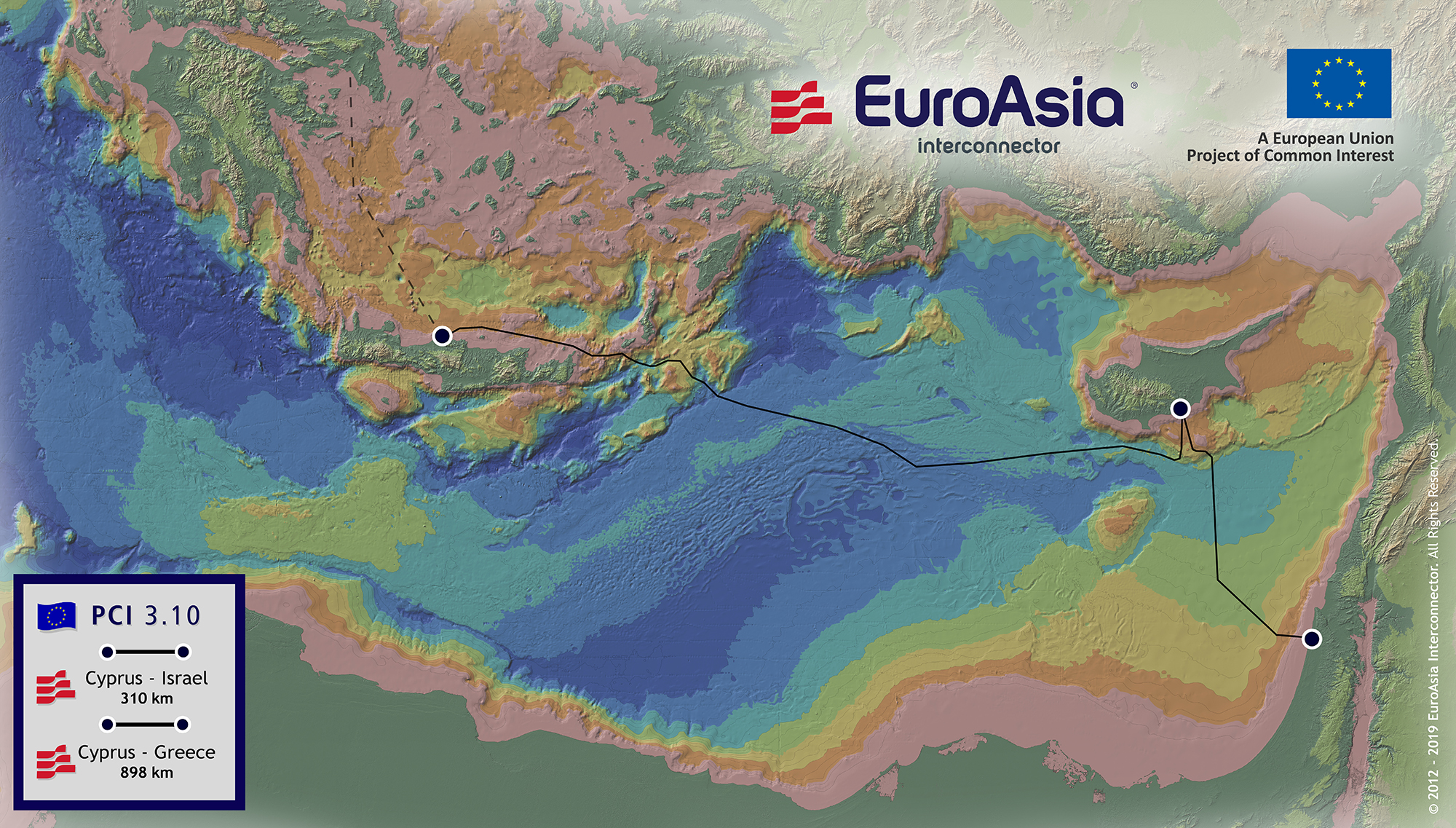
The electrical interconnection with the Greece-Cyprus cable (Great Sea Interconnector-GSI) cannot proceed without the delimitation of Greek-Turkish maritime zones or without informal understanding between the Greek and Turkish governments. But the Republic of Cyprus has not demarcated an EEZ with Turkey either. The two countries do not have diplomatic relations due to the Cyprus problem.
The “3+1” format of Greece-Cyprus-Israel and the US, for now, remains at the level of declarations. For Greece, it is crucial not to be trapped in the logic that its success presupposes the exclusion of Turkey. The goal is an architecture of stability, where Athens takes advantage of the windows of opportunity that open, without entering into a “zero-sum” logic.
If Greece manages to maintain this difficult balance, then developments may truly form a win-win situation for the overall stability of the Eastern Mediterranean.