
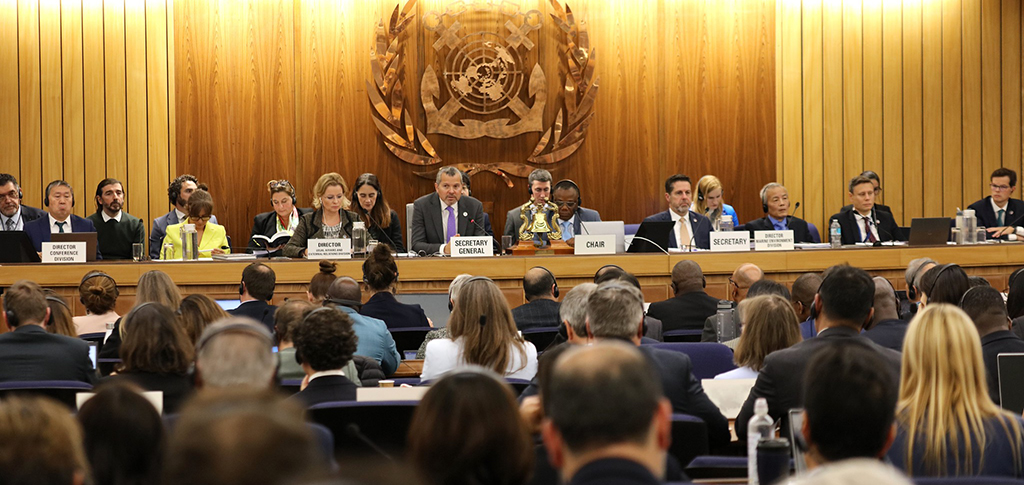
The decision of the International Maritime Organization MEPC/ES.2 session constitutes, in our view, a temporary (?) setback for European diplomacy and a blow to the global momentum for accelerating climate action in shipping.
This is our assessment of the decision to postpone for one year the adoption (or not) of the Net-Zero Framework (NZF).
The MEPC/ES.2 session of the IMO, which concluded today, ended—after strong political pressure, mainly from the United States—in a one-year delay in decision-making.
Although the European Union and its allies pushed for immediate adoption, a coalition of countries prevailed, calling for more time for technical refinement and political consultation.
- In the final vote, 57 states supported the postponement, 49 opposed it, and 21 abstained.
- The proposal was submitted by Singapore, actively supported by the United States and Saudi Arabia, and reinforced by the “technical” argument that more time is needed to finalize the framework.
- As a result, the formal approval and adoption of the NZF is postponed until the end of 2026.
Formation of Alliances
Camp in favor of immediate adoption (49 votes against postponement)
European Union member states, the United Kingdom, Norway, Japan, South Korea, New Zealand, as well as several Pacific island states (e.g. Marshall Islands, Fiji, Tonga), which are already affected by rising sea levels.
They argued that the delay undermines the commitment to net-zero emissions by 2050 and creates uncertainty for investments in clean fuels.
Camp in favor of postponement (57 votes in favor)
The United States (leading role), Saudi Arabia, Singapore, Brazil, India, South Africa, Argentina, and other developing countries with strong oil or energy interests.
They argued that the NZF constitutes a “global carbon tax” that exceeds the IMO’s mandate and would disproportionately burden their economies.
Neutral / abstentions (21 votes)
China and several Middle Eastern countries, while reports suggest that Greece and Cyprus also abstained, sought to maintain a balance, promoting the idea of an “improved technical framework” before adoption.
Political Assessment
For the EU and its allies
In our view, the postponement represents a diplomatic setback for the EU and its allies: the EU had invested significant political capital in promoting the NZF as the first global emissions pricing mechanism for shipping.
The United States, which labeled it an “unacceptable carbon tax,” succeeded in shifting the debate from climate urgency to fiscal competence, neutralizing the momentum behind European proposals.
The delay provides time—but also a political opportunity—for the United States to shape an alternative mechanism based on its national priorities or regional arrangements.
The MEPC/ES.2 session did not lead to a rupture, but to a strategic delay.
The United States gained time and political control over the discussion, while the EU is now called upon to reassess its strategy within the IMO.
The postponement is a setback for immediate action, but it does not cancel the global trajectory toward decarbonization; it highlights, however, how fragile international consensus is on climate governance issues. In any case, support from 49 countries demonstrates that there is a strong core of committed supporters and that the momentum for energy transition has not vanished.
Implications for Shipping and Reactions
1. Regulatory uncertainty
The shipping sector—especially European shipping—will have to operate in a transitional environment where the global framework remains unclear, while EU ETS and FuelEU Maritime will continue to apply.
2. European shipowners’ reaction
European Shipowners (ECSA) expressed regret over the postponement and its implications:
“We regret today’s delay in adopting the international climate agreement for shipping. The IMO Net-Zero Framework is essential to provide the sector with the certainty it needs and to send a strong signal to the market to produce the clean fuels required to achieve net-zero emissions. Shipping is a global industry that requires meaningful global regulations for decarbonization. Global regulation is essential to ensure a level playing field and to achieve the energy transition of international shipping.”
said Sotiris Raptis, Secretary General of ECSA.
3. Industry concerns
The International Chamber of Shipping, a strong supporter of carbon pricing mechanisms, expressed disappointment and stressed that “the industry needs clarity.”
There are growing concerns that individual countries or regions may move ahead independently, creating a fragmented regulatory landscape for the sector.
European shipping bodies emphasized that the sector is global and requires effective global rules to guide decarbonization and ensure a level playing field.
The influential Danish Shipping group also stated that “geopolitics derailed the green transition,” expressing disappointment.
“We did not come here for this. We came to finally conclude a crucial climate agreement for international shipping,”
said Anne H. Steffensen.
4. Investment preparedness
Despite the delay, companies must continue technical preparation (MRV, GFI) and proceed with pilot projects in clean energy.
10/2025