
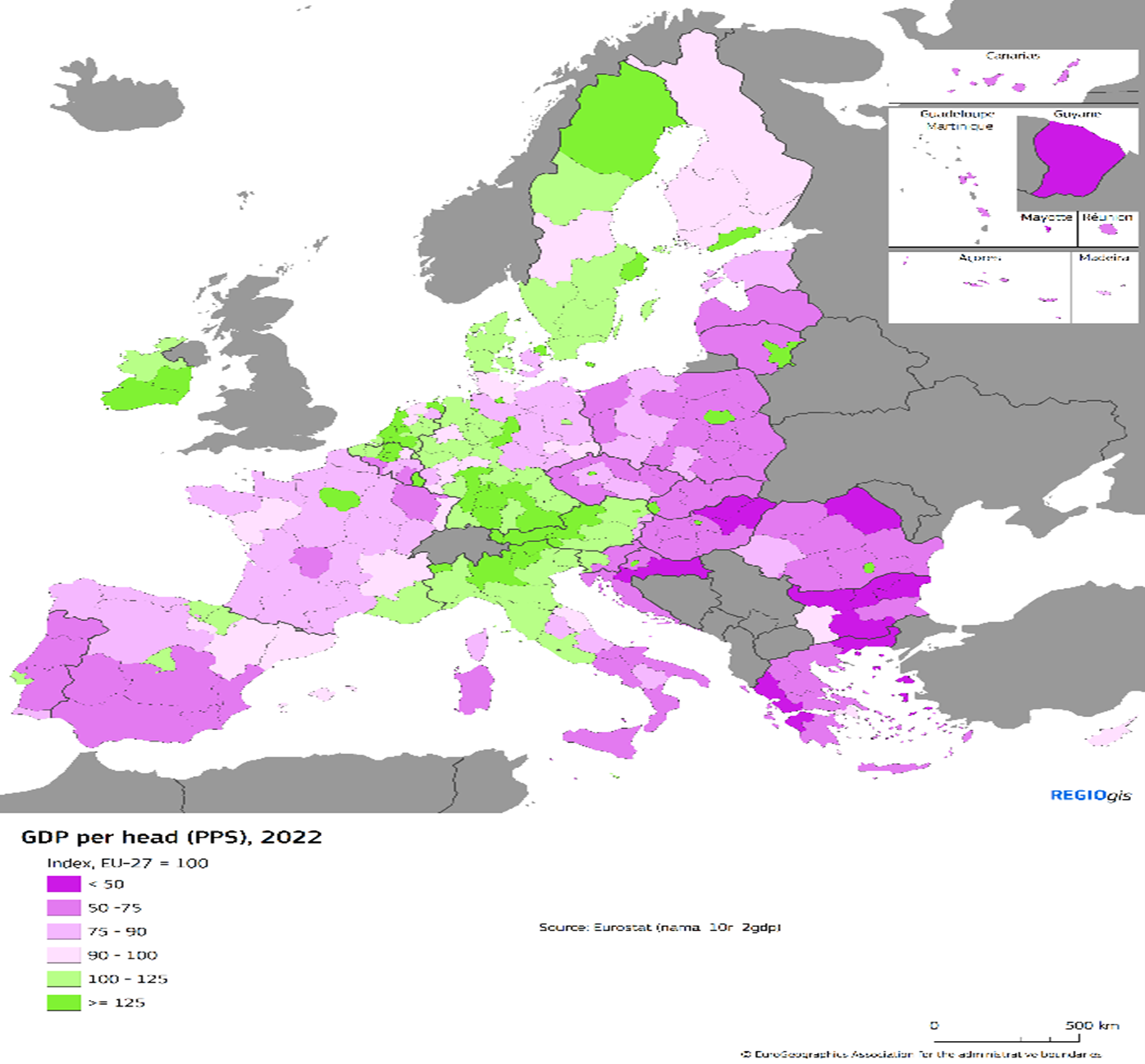
For centuries, Europe was a continent of internal conflicts and wars. A characteristic example is the Ruhr Valley on the Franco-German border, which became a battlefield during the First and Second World Wars over control of coal mines and iron and metal production, both essential to the war industry. From the ashes of these two wars, the first peaceful European agreement was born in 1951: the European Coal and Steel Community, followed gradually by European cohesion policies and programmes.
European cohesion policies were consolidated by the Delors Package (1989–1993), which linked the path towards the Single Internal Market and Monetary Union. These policies financed interventions mainly in countries and regions with GDP below 75% of the EU average. Initially focused on basic infrastructure, they now cover the full spectrum of development: from research and innovation to social inclusion, territorial cohesion and the green transition.
Resources for economic, social and territorial cohesion increased from 20% of the EU budget in 1989 to around 30% today. Conversely, the Common Agricultural Policy (CAP) declined from 60% to approximately 30%. Other EU policies increased from 15% to over 30%, while administrative expenditure fell from 10% to 6.7%.
Key Elements of the Commission’s Proposal for the 2028–2034 Budget
- Cohesion resources increase modestly (from €386.6 billion to €453 billion), but their share of the MFF falls to around 10%, down from approximately 37% today.
- This is because the “traditional” cohesion policy for less-developed regions — including almost all regions of Southeast Europe and the EUSAIR area — is reduced from €350 billion to €218 billion.
- CAP (including fisheries) is reduced to around 15% of the MFF, down from ~32%, and in absolute terms from €386.6 billion to approximately €300 billion.
- By contrast, competitiveness funding, which primarily benefits large enterprises, triples from €130 billion to €410 billion, while defence spending increases fivefold, from €26 billion to €131 billion.
- At least 14% of NRPP national envelopes must be allocated to social priorities (employment, skills, health, housing, social infrastructure) and 43% to climate and environmental objectives.
- Approximately 25% of national envelopes are initially unprogrammed, to be released during crises, during mid-term review, and after 2031.
- Conditionalities are mainly limited to compliance with the European Semester and rule-of-law requirements.
- A single Fund is created through 27 National and Regional Partnership Plans (NRPPs) — one per Member State — replacing the previous dozen or so regional and sectoral programmes.
What These Choices Indicate
- A shift of resources away from Cohesion Policy and CAP towards competitiveness, defence and external action.
- A clear trend towards renationalisation of European programmes, weakening the role of regional and local partners (municipalities, chambers, civil society) in democratic programming, and transferring management to national executive authorities — following the model of the Recovery and Resilience Facility.
- A silent rejection of the Letta Report (on state aid control for large enterprises and deepening the Single Market) and a weakening of the logic of the Draghi Report, which highlighted the role of all regions — strong and weak alike — as a prerequisite for overall European competitiveness.
- Greece’s allocation will amount to €49.2 billion, reduced by €1.7 billion (-3.3%) compared to the current period (€50.9 billion for 2021–2027).
Greece’s share of national envelopes declines slightly from 5.8% to 5.7%.
From 1986 to 2027, Greece has received over €125 billion through Cohesion Policy, approximately €180 billion through CAP, and €30 billion from the Recovery Fund — for a total of over €300 billion.
Greece has been a net beneficiary throughout this period (approximate ratio 1:3). However, this coincided with acceptance of the Single Market and free competition, which, due to structural competitiveness gaps, favoured imports and burdened the trade balance. The logic of the Cohesion Policy, among other objectives, is to compensate for the competitiveness gap of less developed regions and countries, including those in SEE, as they enter and compete in the single market.
- A weakening of existing conditionalities / enabling conditions (Green Deal, macro-regional strategies, rule of law, Charter of Fundamental Rights), undermining — in the name of simplification — the principles of subsidiarity, proportionality, additionality, multi-level governance and partnership.
Enabling Conditions as the Foundation of European Cohesion:
Why Their Removal Weakens the Cohesion Policy after 2027
During the 2021–2027 programming period, the EU introduced Enabling Conditions as a central quality-assurance mechanism for Cohesion Policy. They were not a bureaucratic burden, but a political safeguard, ensuring that EU funds were invested within a framework of institutional capacity, strategic planning and compliance with EU acquis.
What Were Enabling Conditions and Why Were They Introduced
They were horizontal and thematic prerequisites for funding investments under ERDF, ESF+ and CF, etc, including:
- Environmental regulatory frameworks (water, waste, climate adaptation),
- Smart Specialisation Strategies (RIS3),
- sustainable transport planning,
- compliance with the Charter of Fundamental Rights,
- equality and non-discrimination safeguards,
- administrative capacity, public procurement and state-aid rules.
The principle was clear: no investment without institutional foundations.
Their Role in Investment Quality and Cohesion
They functioned as:
- a filter against fragmented, low-value projects,
- a lever for democratic and institutional reform,
- a tool for aligning national policies with EU strategies (Green Deal, Digital Agenda, social rights).
Especially for structurally weaker regions, they acted as a safeguard against clientelism and short-term political interference.
What Their Removal Means in the 2028–2034 Proposal
The Commission proposal effectively abolishes Enabling Conditions, shifting:
- from binding rules → to general political commitments,
- from EU oversight → to national discretion,
- from strategic planning → to implementation flexibility.
This carries serious risks:
- disconnection of investments from environmental and social acquis,
- reduced EU capacity to enforce common standards,
- widening inequalities between strong and weak regions,
- politicisation of resource allocation.
A Progressive Assessment
From a progressive perspective, Enabling Conditions were not obstacles, but guarantees of the public interest. They ensured that EU funds served:
- sustainable development,
- social justice,
- the rule of law,
- long-term convergence.
Their removal does not constitute simplification, but rather an institutional weakening of European principles and policies.
If the EU wishes Cohesion Policy to remain an instrument of democratic and social integration — especially for Southeast Europe — it must reconsider this shift and maintain strong, transparent, progressive and socially oriented conditions along with the thematic concentration option for the use of common resources.
The criticism expressed by the Committee of the Regions, the European Economic and Social Committee and civil society organisations is therefore well-founded: unless amended during consultation, the proposal risks weakening cohesion, socio-economic convergence, democratic governance and the course of European integration.
EU Sources
- European Commission (2025) – Proposal for the Multiannual Financial Framework 2028–2034 and Own Resources reform.
- European Commission (2022) – 9th Cohesion Report: Cohesion in Europe towards 2050.
- High-Level Group on the Future of Cohesion Policy (2024) – Final Report.
- Hhttps://cor.europa.eu/en/news/eu-local-and-regional-leaders-simplification-must-not-lead-centralisation
- https://www.eesc.europa.eu/en/news-media/press-releases/bolder-eu-budget-demanded-eesc-warns-against-centralisation