The quiet, yet deliberate, governmental drift
The government does not openly proclaim any “moving away” from the European strategy. Yet it undermines it—silently and methodically—through choices that, cumulatively, form a clear direction: the country’s strategic alignment with today’s American choices, even when these stand in direct contradiction to the European Union’s collective policies.
Greece’s stance at the International Maritime Organization on decarbonisation was not a neutral “technical divergence.” It was a political positioning that distanced the country from the European core of the green transition—to such an extent that it was publicly acknowledged by Donald Trump himself. When “praise” comes from the main opponent of Europe’s environmental and regulatory strategy, it can hardly be interpreted as a diplomatic achievement.
Energy and infrastructure: from convergence to dependence
The same pattern is reflected in energy policy. European companies representing European interests were, in effect, pushed out of the process of hydrocarbon exploration in Greek offshore blocks, leaving the field exclusively to companies of American interests. This choice is not neutral: it favours the channeling of more expensive U.S. shale gas into Europe and undermines both the possibility of extracting natural gas in these areas—and more broadly the search for cheaper regional solutions—as well as Europe’s collective energy autonomy.
At the same time, the growing American involvement in critical infrastructures—ports, logistics, transport hubs—creates conditions of structural dependence, not strategic parity. This is not a multidimensional foreign policy, but a unilateral strategic shift with long-term costs.
The “Board of Peace” (for Gaza)
A characteristic example of the country’s choices is its participation—initially as an “observer”—in Donald Trump’s “Board of Peace” (for Gaza), at a time when several European leaders express serious reservations, and most major powers (France, Germany, the United Kingdom, Italy, etc.) refused to take part in its inaugural meeting.
The responsibility of the Greek government, the “useful idiots” among Eurosceptics, and social complicity
In a period of profound geopolitical realignment, where great powers redefine roles and alliances, the European Union remains the only supranational project that seeks to combine democracy, social cohesion, a regulated market, and an institutional balance of interests. And yet, instead of this distinctiveness being a source of strategic confidence, it increasingly becomes a target of systematic disparagement.
In this environment, domestic Euroscepticism functions as a political tool. Public commentators and analysts who portray Europe as “declining” or “incapable” contribute to legitimising this strategic shift.
This is not merely well-intentioned criticism of the Union’s weaknesses. It is a methodical “Euroscepticism” which—working in close synergy with the active anti-Europeanism operating in the country—objectively serves as the antechamber of an uncritical pro-Atlanticism, Trump-style. And here precisely a serious political responsibility arises: the responsibility of today’s Greek government and a web of political, economic, and media fellow travellers.
They conceal that Europe remains a global leader in critical high value-added sectors—in industry, in regulating the digital economy, in protecting labour rights, and in the environment. They deliberately downplay the fact that the so-called “investment gap” in frontier technologies is a recognised problem that is being addressed institutionally—rather than evidence of overall failure.
Particularly problematic is also the stance of that segment of citizens who, while disagreeing, choose silence. Tolerance, detachment, and the logic of “nothing changes” function as silent complicity. At critical turning points, neutrality is not neutral; it favours the dominant strategy, even if it undermines collective interests in the long run.
Europe or disintegration
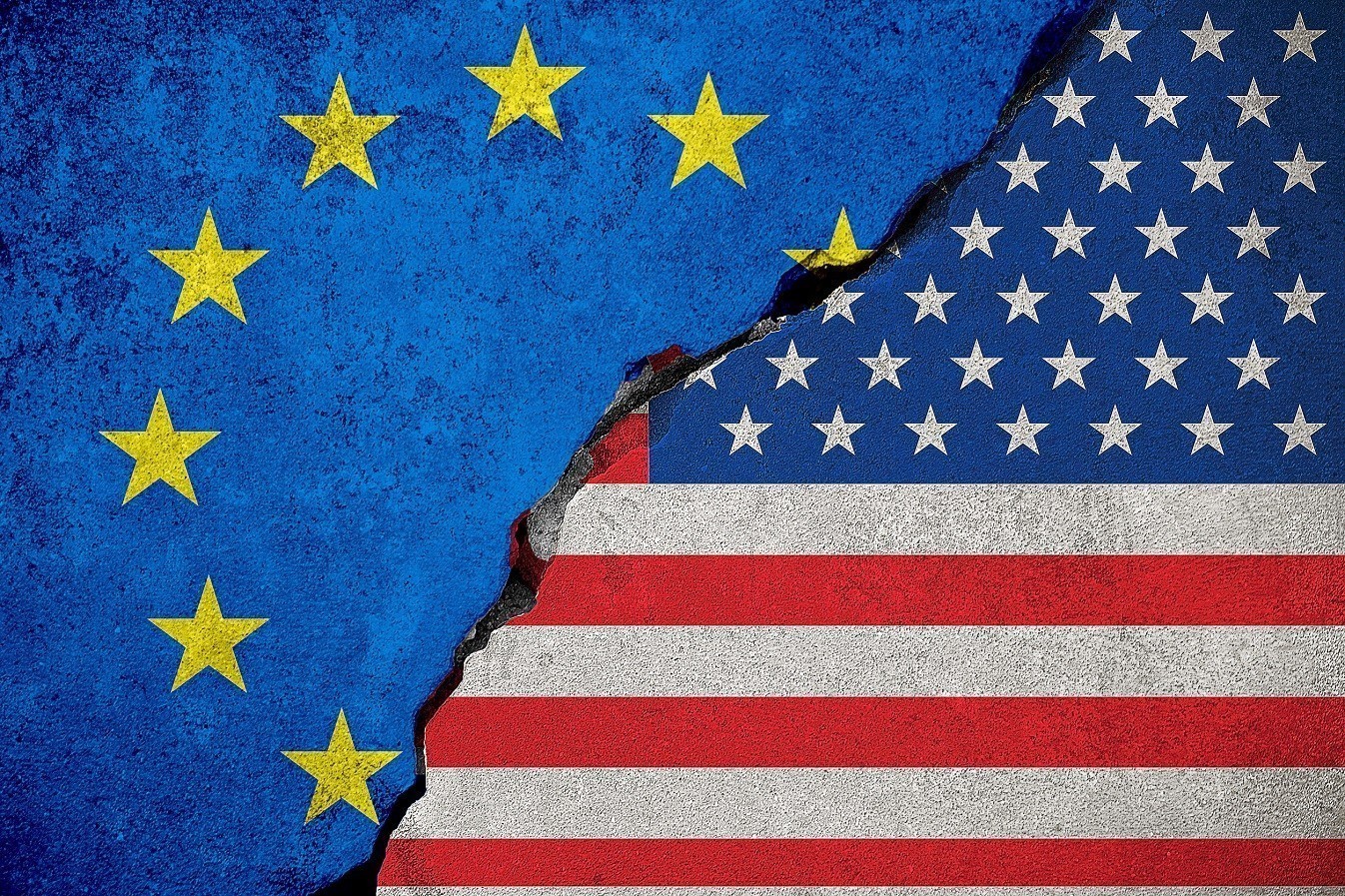
The stake is not “Europe or America,” nor a foolish clash of civilisations. A barren anti-Americanism will offer nothing. The real dilemma is whether Greece will invest in a European strategy of strategic autonomy, democratic regulation, and collective power, or whether it will slide into a piecemeal pro-Trump alignment, where national interests are confused with the short-term pursuits of third parties.
The European Union is not perfect. But it is the only framework within which countries like Greece can have a voice, protection, and prospects. Those who systematically disparage it—and those who remain silent while seeing strategic divergence become entrenched—are not simply critics. They are, objectively, fellow travellers on a path that leads to less sovereignty, greater dependence, and political disorganisation.
The choice, therefore, is political and deeply value-based: European convergence with confidence, or national disorganisation, under the pretext of Euroscepticism and our subjugation to the supposedly unavoidable “adaptation” to the circumstances.