
1. Strategic framework and added value
The present proposal is formulated as an applied policy initiative for connectivity and cohesion in the Balkan and Mediterranean area. Its objective is the development of an integrated Balkan railway and port system, designed to function primarily as a freight transport backbone, with the complementary development of passenger services, interconnecting the three seas of the Adriatic/Ionian, the Aegean and the Black Sea.
Europe’s shift since the 1980s towards large-scale investments in motorways and the expansion of air transport, combined with the collapse of the geopolitical and economic system of unified railway management in the early 1990s following the dissolution of Yugoslavia, contributed decisively to the discontinuation of the railway route Thessaloniki → Skopje → Belgrade → Ljubljana → Zagreb → Trieste, together with its associated port-related freight and passenger flows.
Nevertheless, Thessaloniki remains today at the core of the Orient/East-Med Core Network Corridor (TEN-T), which has the potential to connect the Aegean and South-Eastern Mediterranean with Central Europe and with ports of the Baltic, Northern Europe and the Black Sea.
Trieste remains a key node of the Mediterranean and Adriatic axes.
For this reason, a radial hub-and-spoke railway connectivity model between Thessaloniki and Trieste, linking the ports of the wider region and interconnecting the three seas, can generate economies of scale and resilience and become once again viable, adding value to freight and passenger transport connectivity in the Balkans and the Mediterranean.
At the same time, railway connections with Bulgaria and Romania via Alexandroupolis are being actively promoted, within the framework of a Vertical Axis Aegean–Black Sea. The trilateral cooperation agreement among the three countries aims at strengthening cross-border railway and road infrastructure and is considered of strategic importance for market integration and regional logistics flows.
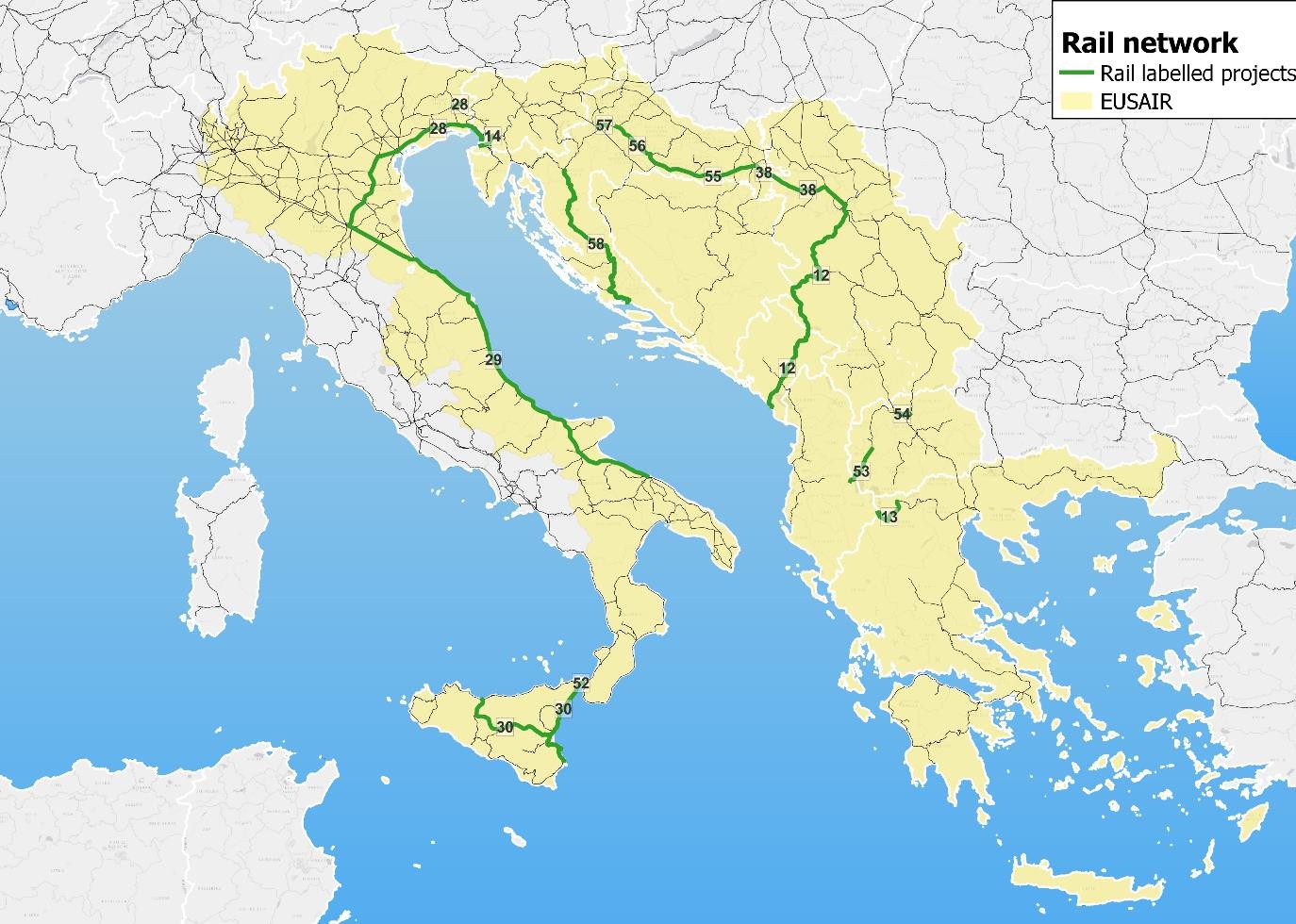
This approach responds to current European priorities concerning the connection of ports and logistics hubs with international railway corridors, resilient supply chains, the green transition and regional integration, and is fully aligned with the planning framework of the Western Balkans Transport Community (https://www.transport-community.org/) and with Pillar 2 (Transport) of the EU Strategy for the Adriatic-Ionian Region (EUSAIR)
(https://www.adriatic-ionian.eu/wp-content/uploads/2025/04/EUSAIR-TRANSPORT-labelled-projects-Final_30.06.23.pdf).
2. Compatibility with the Transport Community planning framework
The Transport Community planning framework for the Western Balkans places emphasis on:
- the upgrading of railway freight transport,
- the reduction of cross-border barriers,
- the convergence of technical and regulatory standards with the EU acquis, and
- the functional connection of ports with the railway network.
The proposed Adriatic/Ionian–Aegean–Black Sea architecture builds upon this framework as an institutional foundation, transforming individual Transport Community interventions into a coherent, multinational system of freight corridors. In this way, the Transport Community can function not only as a harmonisation mechanism, but also as a catalyst for the transition from national projects to regional infrastructure of European scale.
3. Integration within EUSAIR Pillar 2 (Transport)
The proposal is fully aligned with Pillar 2 (Transport) of the EU Strategy for the Adriatic-Ionian Region (EUSAIR), which promotes:
- multimodal connectivity,
- the strengthening of maritime and port gateways,
- sustainable mobility and the modal shift of freight from road to rail and sea.
The inclusion of Thessaloniki and Trieste as bridges between the Adriatic-Ionian macro-region and the Balkan space functionally extends the EUSAIR logic towards the Aegean and the Black Sea, enhancing coherence between macro-regional and trans-European policies.
According to the EUSAIR Transport Pillar Master Plan, the following projects are promoted with a 2030 horizon:
- Upgrading and reconstruction of the Belgrade–Bar railway line (E79)
- Cross-border railway “missing link” between Greece and Albania (Florina–Pogradec section)
A project of strategic importance for Aegean–Adriatic connectivity and Albania’s integration into the European railway network. - Construction of the second railway track Divača – Port of Koper
- Multimodal Northern Adriatic Corridor
Connecting ports, railways and hinterland in Slovenia, Croatia and Italy. - Multimodal Central Adriatic Corridor
Strengthening maritime and land connections between the Central Adriatic and the Balkans. - Upgrading of the Palermo – Catania – Messina railway axis
(EUSAIR Italian dimension)
Improving Southern Italy’s connectivity with the Adriatic and the Eastern Mediterranean. - Upgrading and reconstruction of the Belgrade – Zagreb railway line
A central intra-Balkan axis with strong freight significance. - Construction of the Corridor VIII railway section Kičevo – Albanian border
Completing the East–West Adriatic–Black Sea axis. - Railway connection between Skopje main passenger station and Skopje airport,
(where the Thessaloniki–Skopje railway line and its connection to Central Europe should also be explicitly included). - Reconstruction of the Okučani – Vinkovci railway section
Part of a critical Croatian freight corridor. - Upgrade, renewal, construction of second track and new double-track sections on the Dugo Selo – Novska line
Increasing capacity and reliability of the Croatian core railway network. - Modernisation of the Zagreb Kustošija – Zagreb West Station – Zagreb Main Station section
An urban node critical for passenger and freight flows. - Modernisation of the M604 Oštarije – Knin – Split railway line
Improving the connection of the Port of Split with the Balkan hinterland.
4. Architecture of the proposed system
The system is based on a radial hub-and-spoke model, primarily freight-oriented, supported by multiple maritime and railway corridors:
- Thessaloniki as the central Aegean hub and convergence point of Balkan axes,
- Trieste as the Adriatic hub and gateway to Central Europe,
- radial connections to the main Western Balkan ports,
- an eastern axis Thessaloniki–Alexandroupolis–Bulgaria–Istanbul, with the objective of Black Sea connectivity,
- a western axis along the Railway Egnatia, from Alexandroupolis to Igoumenitsa and the Italian Adriatic ports, forming a horizontal Aegean–Ionian–Adriatic corridor
(which should be added as a project to the EUSAIR Transport Pillar Master Plan).
Within this framework, the system integrates all major freight and passenger ports of the Western Balkans:
- Rijeka and Ploče (Croatia),
- Koper (Slovenia),
- Bar (Montenegro),
- Durrës and Vlora (Albania),
- as well as supplementary passenger and regional ports along the Adriatic and Ionian coasts.
The Italian axis is supported by a network of ports with developed freight and passenger activity, notably:
- Trieste, Venice and Ravenna in the Northern and Central Adriatic,
- Ancona and Bari in the Central and Southern Adriatic,
- Brindisi and Taranto as gateways to Southern Italy and the Mediterranean.
The connection of Igoumenitsa and Patras with these Italian ports through regular intermodal and passenger maritime services complements the Thessaloniki–Trieste axis and creates a mesh of alternative and resilient routes for freight and passenger movement between the Balkans and Italy.
Passenger transport is functionally integrated as a complementary dimension, utilising the same upgraded infrastructure and reinforcing territorial and social cohesion.
5. Synergies of financial instruments
Implementation relies on multi-level financial synergies, including the new EU Cohesion Framework 2028–2034:
- Interreg CBC and IPA programmes to support institutional cooperation, corridor governance bodies, and pilot freight and passenger services,
- IPA ADRION as a macro-regional coordination platform for studies, projects and actions in EUSAIR,
- the Connecting Europe Facility (CEF) for critical railway and port infrastructure and interoperability within TEN-T,
- national/sectoral transport programmes of EU Member States and accession countries to ensure long-term integration and operational sustainability of road, rail and port multimodal networks.
These synergies enable the transition from fragmented interventions to a coherent European strategy for freight and passenger transport in the wider region.
6. Synthetic presentation of the port and connectivity network
The proposed Integrated Railway and Port System constitutes a single geographical and functional mesh encompassing all major freight and passenger ports of the Balkans, without hierarchical exclusions or fragmented references.
In the Western Balkans, the system integrates the ports of Rijeka and Ploče (Croatia), Koper (Slovenia), Bar (Montenegro), and Durrës and Vlora (Albania). These ports act as principal gateways for freight flows to and from the Balkan hinterland, while also maintaining a significant role in passenger and coastal connectivity in the Adriatic and Ionian seas.
On the Italian side of the Adriatic, the system is functionally connected to Trieste, Venice and Ravenna in the northern and central Adriatic, as well as Ancona, Bari, Brindisi and Taranto in the southern Adriatic and Southern Italy. These ports form a dense network of freight, passenger and intermodal connections, complementing the central Adriatic–Aegean axis and offering alternative and resilient routes to Western and Central Europe.
This western dimension is decisively strengthened by the prospective development of the Railway Egnatia towards Igoumenitsa, transforming it into a western gateway of the Greek and Balkan space. Through regular maritime freight and passenger services with Italian Adriatic ports, Igoumenitsa and Patra complements and reinforces the Thessaloniki–Trieste axis, endowing the system with characteristics of multimodal resilience.
At the same time, the eastern axis extends from Thessaloniki to Alexandroupolis, Bulgaria and Turkey, connecting the Aegean with the Black Sea and integrating the Balkan network into broader freight and passenger corridors towards the Eastern Mediterranean, the Black Sea and Asia.
At the centre of all these axes lies Greece, and in particular Thessaloniki, which emerges as a nodal point for the convergence and redistribution of flows between the Adriatic and Ionian, the Aegean and the Black Sea. Its geographical position, combined with railway connectivity in all directions, enables it to function as a hub of three maritime basins and as a natural gateway of the European Union towards the Balkans and the Eastern Mediterranean.
The concentration of freight flows in this Greek core creates the conditions for the development of reliable and sustainable passenger services, while simultaneously reinforcing economic cohesion, geopolitical stability and the country’s trans-shipment role within the European and Eurasian transport system.
7.The Blue Corridor (Adriatic–Ionian Corridor) in the Western Balkans
The Adriatic–Ionian Corridor, widely known as the Blue Corridor, constitutes one of the most strategically significant transport axes in the Western Balkans. Designed as a multimodal north–south corridor, it connects Northern Italy with Slovenia, Croatia, Bosnia and Herzegovina, Montenegro, Albania and Greece, extending through the Ionian axis to the southern Peloponnese. While primarily conceived as a modern motorway system, the corridor carries broader strategic relevance, as it complements and interacts with regional railway development and port connectivity in the Adriatic and Ionian basins. The project is supported under the Western Balkans Investment Framework (WBIF) as part of the EU enlargement and connectivity agenda, reinforcing economic integration, cross-border mobility and regional cohesion. By linking Adriatic ports with Balkan hinterlands and the Greek transport network, the Blue Corridor strengthens supply chains, facilitates freight flows and enhances passenger mobility, thereby contributing to the gradual integration of the Western Balkans into the European transport system and the broader Trans-European Network (TEN-T) framework. It is in synergy and complementarity with the integrated Balkan railway and ports system.
8. Concluding assessment
The proposed chapter constitutes a mature policy proposal for the future of Balkan and Mediterranean connectivity. Its effective implementation requires modern transnational governance bodies under unified European coordination, in cooperation with national and regional authorities of the wider region and with the European Commission’s Directorates-General DGs REGIO, MOVE, ENEST, MARE and ENV.
Its institutional alignment with the WB Transport Community and EUSAIR Pillar 2 (Transport), combined with full integration into the Trans-European Transport Network (TEN-T) and the synergy of European and national financial instruments, can shape an Integrated Adriatic/Ionian–Aegean–Black Sea Railway and Port System as a central axis of sustainable policy for the Balkans and the Mediterranean in the coming decade.