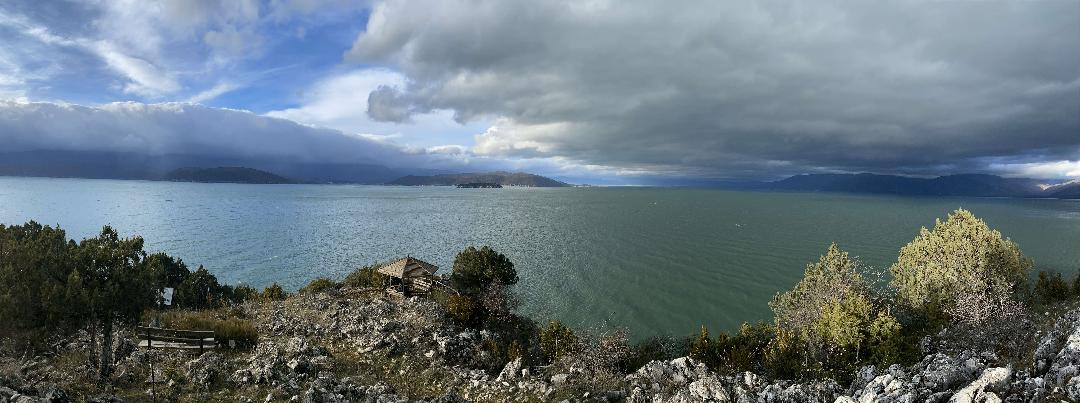
At the point where the borders of Greece, Albania, and North Macedonia meet, the Prespa basin forms a rare wetland of international importance. It is also a unique “living laboratory,” where the idea is put into practice that nature knows no borders and that cooperation can flourish even in geopolitically complex regions.
The history of cross-border cooperation in the area did not begin in ministerial offices, but from the grassroots. In the early 2000s, environmental organizations and local actors laid the foundations that led to the historic Declaration of the Prime Ministers for the creation of the Prespa Park. The distinctive feature of this first period was equal participation: governments, NGOs, and local communities sat at the same table, building relationships of trust in a region that for decades had been divided by the barbed wire of the Cold War.
Over the years, the need for more stable structures became pressing. The Trilateral Agreement of 2010, which entered fully into force in 2019, led to the establishment of the Prespa Park. Today, official bodies meet to address critical issues such as water management and the protection of biodiversity, with a characteristic example being the joint midwinter bird counts carried out on all three sides of the borders. However, bureaucratic delays and political changes have shown that interstate agreements, although necessary, are often insufficient for the day-to-day resolution of problems.
In response to this challenge, the municipalities of the region in all three countries have put forward a proposal that aims to change the landscape: the creation of a European Grouping of Territorial Cooperation (EGTC). This is a legal instrument of the European Union that can free the hands of local authorities for the sustainable development of the cross-border area, alongside the protection of its biodiversity. Through the Prespa EGTC, the municipalities of the three countries will acquire legal personality as a single body, with competences across the entire cross-border area and the ability to seek and manage European funds autonomously. The Prespa EGTC will be able to implement projects that improve residents’ quality of life—such as infrastructure, public services, and ecotourism initiatives—linking ecology with the local economy.
The vision for Prespa is based on successful examples from elsewhere in Europe, such as that of Europe’s other cross-border lake shared by three countries, Lake Constance (Bodensee), which is shared by Germany, Switzerland, and Austria. Experience there has shown that when strong institutions and local government participation exist, cross-border cooperation can endure over time and deliver tangible results, such as cleaner waters and economic and social well-being.
Beyond the Lake Constance example, there are also EGTCs that combine the protection and management of biodiversity with economic and social development, most notably the EGTC “ZASNET” between Spain and Portugal, which succeeded in linking sustainable development with biodiversity and led to the creation of the cross-border Biosphere Reserve “Meseta Ibérica.” Similarly, the EGTC “Alpi Marittime–Mercantour” on the French–Italian border, the first of its kind for protected areas, focuses on joint operational actions such as wildlife reintroduction and ecotourism, while the EGTC “Duero–Douro” (Spain–Portugal) aims at the integrated management of Natura 2000 areas alongside rural development. Beyond EGTCs, the text refers to the Wadden Sea (Germany–Netherlands–Denmark), governed through Trilateral Cooperation and a joint Secretariat; the Danube and Rhine river basins, managed by international commissions; and Lake Neusiedl–Fertő (Austria–Hungary), where a participatory committee combines nature protection with local activities such as wine tourism.
The establishment of the Prespa EGTC marks the necessary institutional and operational “coming of age” of the region, untangling the “Gordian knot” of bureaucracy. By making use of the legal instrument of European Regulation 1082/2006, the municipalities now cooperate under a single legal personality that functions as a direct beneficiary of EU funds, bypassing time-consuming and often incompatible national procedures. At the same time, this new model of multilevel governance serves as a vital “bridge” of Europeanization for Albania and North Macedonia. Through the transfer of know-how and joint management, neighboring municipalities align themselves in practice with the European acquis, turning everyday cooperation into a school of institutional maturity and substantive development.
Prespa aspires to show the way in which borders can be transformed from obstacles into bridges. With the institutionalization of the EGTC, the region hopes to enter a new era in which nature protection and human prosperity move forward hand in hand. By taking the fate of their place into their own hands, the municipalities demonstrate that the common destiny that unites them is stronger than the lines on maps. This endeavor stands as a beacon of hope for the Balkans, showing in practice that peaceful coexistence and shared progress are built daily through cooperation and mutual respect.