An intersectoral workshop at the Polytechnic University of Marche brought together institutions, researchers, businesses and local initiatives to create connections between sustainable food systems, health, biodiversity, culture, tourism and innovation.
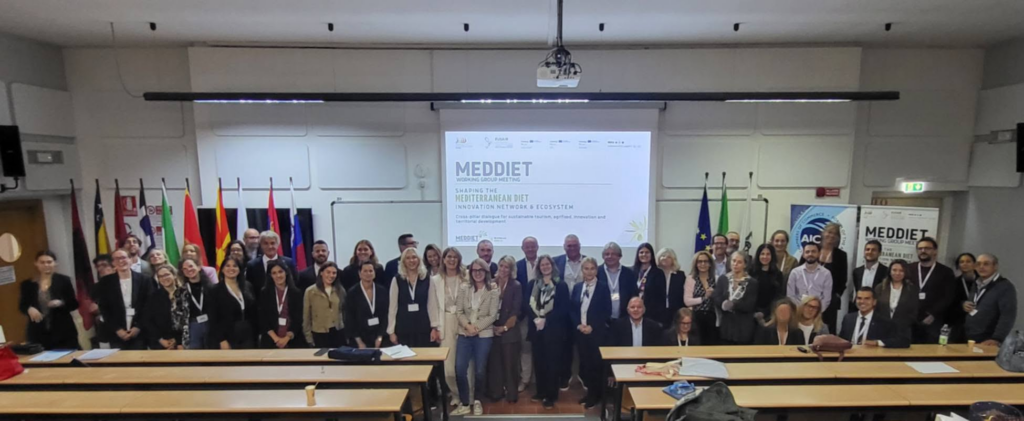
On 16 October 2026, the meeting of the MEDDIET Working Group of the European Union Strategy for the Adriatic-Ionian Region (EUSAIR) was held at the Faculty of Economics of the Polytechnic University of Marche (UNIVPM), as part of an interactive policy workshop entitled “Towards a network and ecosystem for Mediterranean Diet innovation within EUSAIR”. The event brought together representatives of European and national institutions, regional authorities, universities, research organizations, Chambers of Commerce, businesses and other stakeholders from all over the Adriatic-Ionian Region.
Jointly organized by the Marche Region and the Forum of the Adriatic and Ionian Chambers of Commerce (AIC Forum), in collaboration with the Polytechnic University of Marche and the Adriatic-Ionian Initiative (IAI), the meeting took place within the framework of the Italian Presidency of the European Union Strategy for the Adriatic-Ionian Region (EUSAIR) for the period 2026–2027.
The workshop focused on the potential for developing a macro-regional network and ecosystem for the innovation of the Mediterranean Diet within EUSAIR. The MEDDIET flagship project was born from the transversal cooperation between the EUSAIR 1 (Sustainable Blue Economy), 4 (Sustainable Tourism) and 5 (Social Cohesion) pillars, recognizing in the Mediterranean Diet a shared resource capable of connecting local food systems, cultural heritage, coastal and rural communities and sustainable territorial development. After being developed through dedicated meetings of working groups and discussions held within the framework of the annual EUSAIR Forums, the Ancona meeting represented a further step towards the translation of this shared strategic vision into concrete forms of cooperation in the entire Adriatic-Ionian Region.
Starting from the EUSAIR-S3 workshop held in Izola in September 2026, during which the operational logic of cooperation for innovation at the macro-regional level was presented and tested, the workshop explored the possible ways of applying this approach to the Mediterranean Diet. In particular, the opportunities for linking EUSAIR priorities and those of existing innovation skills, competences and ecosystems within the regional smart specialization strategies (S3) were examined, with the aim of identifying thematic affinities and potential opportunities for collaborative innovation. The Mediterranean Diet has been considered not only as a nutritional model and food tradition, but also as an area full of opportunities to develop synergies between the agri-food sector, sustainable food systems, health, biodiversity, cultural heritage, tourism, research and innovation and territorial development.
The workshop explored the prospects for the development of a network for the innovation of the Mediterranean Diet, capable of connecting the relevant actors of the Adriatic-Ionian Region and supported by a broader ecosystem of regional S3 priorities, research institutes, businesses, public authorities and territorial partnerships. Through inspirational speeches, presentations of practical experiences and three participatory sessions based on the World Café methodology, participants identified opportunities for cooperation, relevant expertise and possible pilot initiatives, while discussing the necessary conditions for implementation, knowledge transfer, governance and long-term macro-regional cooperation.
The aim of the workshop was to identify the first signs of cooperation and the most promising areas of opportunity, to map relevant regional resources and expertise, and to define shared priorities and concrete and realistic actions for the next steps. The results of the three World Café sessions contributed to the elaboration of the Ancona Recommendations, translating the discussions and proposals that emerged during the workshop into a series of indications aimed at guiding the further operational development of the MEDDIET flagship project and strengthening collaborative innovation through the EUSAIR–S3 cooperation pathway.
Gilles Kittel, representing the Directorate-General for Regional and Urban Policy of the European Commission (DG REGIO), illustrated the development of the MEDDIET flagship project within EUSAIR, highlighting its role in translating a shared vision into concrete forms of cooperation in the entire Adriatic-Ionian Region. It retraced the main stages of the initiative: from the adoption of the updated EUSAIR Action Plan in May 2025, which included the promotion of the Mediterranean Diet and local, organic and origin-related productions, to the creation of the MEDDIET flagship project by Pillars 1, 4 and 5 during the workshop held in Bari in September 2025. Kittel emphasized the transversal value of the Mediterranean Diet, capable of connecting the sustainable blue economy, sustainable tourism and social cohesion. Local food systems and cultural heritage are in fact a link between coastal and rural communities and contribute to sustainable economic development. He then illustrated the prospects for the development of a macro-regional network and ecosystem for the innovation of the Mediterranean Diet, capable of bringing together the relevant actors, the regional priorities of smart specialization (S3), research and higher education institutions, companies, public authorities and existing territorial partnerships. Finally, he explained that the Ancona meeting aimed to identify the first operational elements needed to build this framework of cooperation, including regional skills and resources, potential pilot nodes, transferable good practices and shared priorities on governance, knowledge transfer and skills development.
The opening session outlined a central message for the workshop: the Mediterranean Diet can become a concrete tool for cooperation when its cultural and food heritage is related to innovation, health, sustainable tourism, biodiversity and new opportunities for regional economies.
https://www.forumaic.org/meddiet-ad-ancona-costruire-una-rete-di-innovazione-adriatico-ionica-intorno-alla-dieta-mediterranea/
Plenary return of the interactive cross-sectoral dialogue between the pillars (World Café session)
The core working session adopted the World Café format to take participants from listening to collaborative policy design. Multidisciplinary groups alternated with thematic tables, led by facilitators, allowing each group to contribute in depth to all topics.
The methodology made it possible to link the interventions of the experts in the morning to concrete issues related to priorities, actors involved, capacities and methods of implementation. The session ended with a plenary discussion during which the facilitators summarized the main priorities, opportunities for cooperation and the proposed next actions that emerged from the different working tables.
Theme 1: Common vision and territorial strengths
Facilitators: Daniela Guida and Gianluigi Cardone (CIHEAM Bari)
The aim of the session: to deepen how the Mediterranean Diet can become an effective engine of sustainable regional development in the entire Adriatic-Ionian Region. The group worked to identify the territorial strengths, identities and consolidated experiences that could form the shared basis of the MEDDIET network, overcoming a generic enhancement of the Mediterranean Diet to arrive at a targeted and operational cooperation framework.
Main findings from the plenary discussion:
- Economic development and tourism: the Mediterranean Diet is an important tool to strengthen short supply chains, connect small producers to markets, support farmers in marginal areas and promote sustainable tourism.
- Strategic approaches: Priority should be given to education, health, public awareness and role models such as One Health and LEADER, the participatory approach to local development.
- Shared identity: the foundations of the network should be based on the gastronomic heritage, agrobiodiversity, rural and maritime cultures and certified quality products of the region, also evaluating the possibility of adopting a common brand dedicated to the Mediterranean Diet.
- Knowledge sharing and funding: It is crucial to build on existing experiences and broaden the scope of successful initiatives through cooperation programmes, including Interreg. The participants proposed the creation of a Good Practice Hub or a digital platform to collect, network and share projects throughout the macro-region.
Theme 2: Smart specialisation ecosystems and potential network nodes
Facilitators: Ilijana Radaković (Polytechnic University of Marche) and Alessio Niosi (AIC Forum)
Objective of the session: to examine which smart specialisation (S3) priorities, organisations and innovation ecosystems — such as competence centres, living labs, biological districts, universities and Chambers of Commerce — can serve as initial pilot nodes of the MEDDIET network. The aim is to enhance existing capacities, avoiding the creation of parallel structures.
Main findings from the plenary discussion:
- Education and awareness-raising: it is essential to promote targeted educational paths from a young age, aimed at both consumers and small and medium-sized enterprises.
- Continuous exchange of knowledge: Overcoming fragmentation between different stakeholders requires constant dialogue, rather than sporadic meetings. This allows for a continuous exchange of knowledge, while allowing each country to focus on its own priorities and contribute to those of others through stronger networks.
- Cross-sectoral multiplier effect: Participants underlined the importance of generating a multiplier effect by overcoming traditional separations between sectors. Active collaboration between public administrations, universities, local SMEs, farmers and the tourism sector can transform isolated projects into interconnected and resilient territorial ecosystems.
- Extensible and replicable impact: when knowledge, financial instruments and innovation rooted in the territories are aligned, macro-regional cooperation can generate tangible economic, social and environmental benefits, which can be extended and replicated throughout the Adriatic-Ionian Region.
Theme 3: Governance, knowledge and skills
Facilitators: Iva Čaleta Pleša (EUSAIR Pillar 4 Coordinator) and Martina Klapan Štambuk (EUSAIR Pillar 5 Coordinator)
The aim of the session: to identify a lean and functional governance model to support the preparatory phase of the network, together with the skills, knowledge transfer mechanisms and immediate actions necessary to move from theoretical confrontation to operational cooperation.
Main findings from the plenary discussion:
- Multi-level governance emerged as a central concept for the future development of the MEDDIET Flagship. Participants repeatedly stressed that the Mediterranean Diet can only be promoted and managed effectively through the active involvement of different stakeholders at the political, institutional, research, project and operational practice levels.
- The EUSAIR governance model has been identified as a good example for the MEDDIET initiative. A governance structure that integrates political leadership, technical expertise, project implementation and stakeholder engagement could provide a balanced and sustainable framework for the continuation of the Flagship.
- The MEDDIET Flagship should continue to be integrated into the EUSAIR framework. Participants stressed the importance of maintaining the strategic and political dimension of the initiative, while strengthening cooperation between relevant ministries, regional authorities and international organisations.
- A distinction should be made between the level of governance and the level of project implementation. Governance should define strategic directions, ensure coordination and promote stakeholder engagement, while project-level activities should focus on concrete actions, expected results, funding opportunities and measurable results.
- Universities, research institutes and vocational education and training (VET) organisations play an important role in connecting different stakeholders. Their ability to bring together policymakers, researchers, students, practitioners and private sector representatives can contribute significantly to the long-term sustainability of the initiative.
- The active involvement of SMEs and industry players needs to be further strengthened. Their participation is essential to ensure that governance structures and future actions are closely linked to concrete needs, market opportunities and innovation potential.
- Future activities should be based on solid evidence and a needs analysis. Participants highlighted the importance of analysing existing initiatives, identifying thematic priorities and building on successful experiences and networks already operating in the Mediterranean area.
- Knowledge sharing and cooperation with existing networks should be deepened. Synergies with established initiatives at Mediterranean and European level, including networks active in the fields of culture, tourism, food and innovation, can help to avoid duplication and maximise the impact of activities.
- Certification, branding and awareness-raising were identified as promising areas for future cooperation. Ideas discussed include the development of a Mediterranean Diet Guide, the definition of certification criteria, branding strategies, training programs, living labs and the promotion of certified quality products consistent with the values of the Mediterranean Diet.
- The long-term success of the MEDDIET Flagship will depend on the ability to maintain continued political commitment while achieving concrete and measurable results through projects and partnerships.
Financing perspectives and next steps
Nomisma SpA and member of the StEP technical assistance group of the Marche Region, outlined possible funding opportunities to support the MEDDIET cooperation. He pointed out that while funding is now consolidated for the transport, energy and environment pillars, it is even less defined for the blue economy, sustainable tourism and social cohesion. These areas, which significantly involve small and medium-sized enterprises active in fisheries, tourism and food systems, have traditionally relied on Interreg programmes or national funding, rather than on large international financial institutions. Looking ahead, in the European Union’s multiannual financial framework for 2028–2034, Interreg programmes will continue to be one of the main sources of transnational funding. Sectors such as agriculture and fisheries will instead be integrated into the new National and Regional Partnership Plans (NRPPs), designed to rationalise resources through a new centralised fund. The presentation identified several possible sources of funding for MEDDIET initiatives, including the Sustainable Blue Economy Partnership (SBEP), which supports projects dedicated to, for example, ecosystem-based services. It was also highlighted that institutions such as the European Investment Bank (EIB) and the European Bank for Reconstruction and Development (EBRD) are increasingly making available credit lines and grants specifically aimed at SMEs to support sustainable agriculture, the green transition and ecosystem-based tourism.
-
Participating in the three thematic workshops as a representative of the Region of Thessaly, Greece, Georgios Emmanouil presented the following proposals: https://emmanouilreview.eu/ankona-evropaiki-synergasia-gia-ti-mesogeiaki-diatrofi-kai-ti-viosimi-anaptyxi-ton-topikon-koinonion-tou-giorgou-a-emmanouil-melous-tis-omadas-ergasias-eusair-gia-tin-mesogeiaki-diatrofi/